Archive | May, 2017

Our Week With Eric Church, Carole King, the Bandit and the Nashville Predators

30 May

It has been an eventful week in the SBI World, and we have spent a lot of time in the city 30 miles to the west. For those not up on local geography, that city is Nashville.

On Monday night, we had tickets for Game 6 of the Western Conference Finals in the National Hockey League. The Nashville Predators have been on a magical run through the playoffs and have taken over the city. Long time Predator fans are not happy with the bandwagon people, but we felt that Game 6 was a must-see event. They clinched the championship, and I got to High Five the country music star who sat in front of us. I have no idea who he was, but my wife was not happy that I got to touch him and she did not.

On Tuesday night, I was back in Nashville for a fundraiser. Cumberland University, where I work, is the home of the Martin Van Buren Papers, and a Nashville attorney hosted an event to assist with that project. He has an amazing collection of historic artifacts and opened his office for tours. People paid to see documents signed by George Washington, Abraham Lincoln, Martin Luther King, Davy Crockett, King George III and various other people. It was interesting to see everything and to hear the stories of how the collection came together.

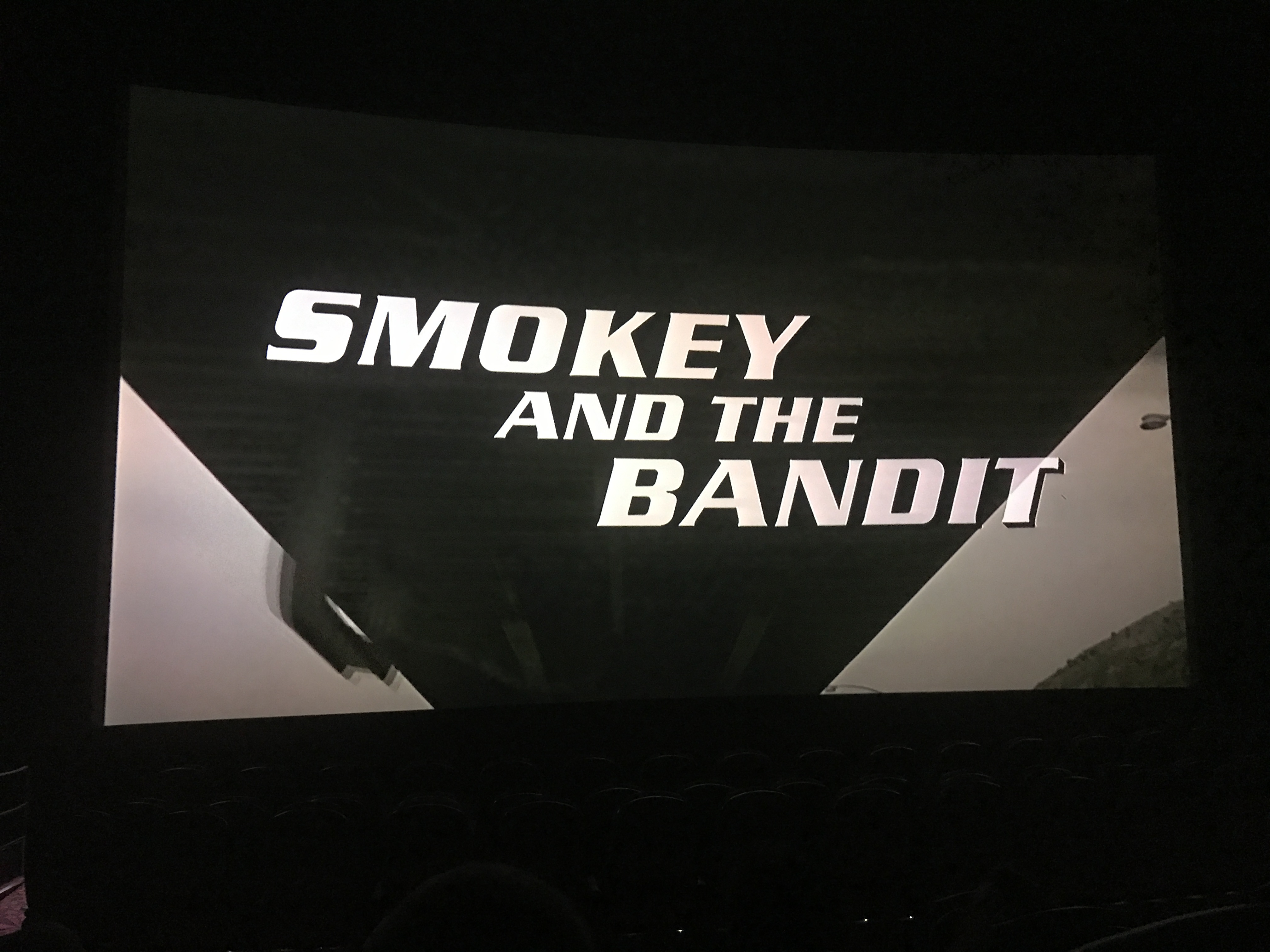
On Wednesday night, I went with my brother and my nephews to a truly cultural event. We went to the theater to see the 40th Anniversary screening of Smokey and the Bandit, a movie that I have seen a million times.

It was great to see the Bandit, Snowman and Buford T. Justice on the big screen, but it was also great to see people with their t-shirts. As bandit tells Snowman when they get to the warehouse full of Coors beer, it was “redneck heaven.” After it was over, I wanted to get a diablo sandwich and a Dr. Pepper.

On Friday night, it was back to Bridgestone Arena, home of the Predators. However, we were not there for a hockey game. We were there to see Eric Church in concert.

I do not know much about the singer, but we had already seen him at a Kris Kristofferson tribute concert. This one was more rocking and raucous. Eric Church is known for wearing sunglasses, and it was funny to see all of the guys in the crowd wearing sunglasses. I reckon that thought some female would mistake them for the performer.

On Sunday night, we went to the Tennessee Performing Arts Center to see Beautiful: The Carole King Musical. It was a great show about the life of a prolific songwriter who also creating on of the great albums of all time. Through professional success and personal tribulation, she wrote songs that became part of the soundtrack for a generation. Now, we have to see the real person in concert.

At some point, I made the statement that I was not going to go into the city for a while. However, I will it will happen because there is too much cool stuff there to do. This week was just a small sample of that.

Movie Wisdom – Tom Sizemore Edition

21 May

This afternoon was a good time to watch television. It was hot and rainy outside, which is not a great combination. Flipping through channels, I found Devil in a Blue Dress, a movie that I can always watch. I will not go through the story, but, as it pertains to this post, Don Cheadle shoots Tom Sizemore.

When that movie was over, I went to the guide and found Heat, a great movie starring Al Pacino and Robert De Niro. It also has Tom Sizemore, and I changed the channel in time to see him get shot.

Therefore, this has been a Tom Sizemore day. I saw him get shot in two movies, and, coincidentally, both movies were released in 1995. Tom had a killer year.

Figuring that all of this was fate, I decided to look for wisdom in the movies of Tom Sizemore.

From Born on the Fourth of July

Thou shalt not kill.

From Point Break

Fear causes hesitation, and hesitation will cause your worst fears to come true.

From Harley Davidson and the Marlboro Man

Never chase buses or women. You’ll always be left behind.

The right woman can make you, and the wrong woman can break you.

From Passenger 57

Always bet on black.

Trust your instincts.

From Wyatt Earp

I think the secret old Mr. Death is holding is that it’s better for some of us on the other side.

Nothing counts so much as blood. The rest are just strangers.

From Natural Born Killers

Nobody can stop fate.

The media is like the weather, only it’s man-made weather.

You can’t hide from your shadow.

From Devil in a Blue Dress

You step out of your door in the morning, and you are already in trouble. The only question is are you on top of that trouble or not?

All you got is your friends.

From Saving Private Ryan

FUBAR

From Pearl Harbor

There’s nothing stronger than the heart of a volunteer.

A brilliant man would find a way not to fight a war.


Interview with C-SPAN’s Brian Lamb

9 May

If any of you are interested in presidential history, then check out my colleague on C-SPAN this Sunday.

Mark R. Cheathem's avatarJacksonian America: Society, Personality, and Politics

Last month, I had the privilege of sitting down with C-SPAN founder Brian Lamb and being interviewed for his show, Q&A. It was a heady and nerve-wracking experience, not the least because I had been sick for a couple of days before I flew to D.C. (Remember that when you watch the interview.) We talked about Andrew Jackson, Southerner and spent a lot of time on the Trump-Jackson comparisons. It was a great experience, and I want to thank Brian and Q&A producer Nik Raval for asking me to do the interview.

If you’re interested in seeing the interview, it will be on C-SPAN this Sunday evening, May 14, at 8E/7C and again at 11E/10C.

View original post

The Rocket Scientist Next Door

8 May

A few weeks ago, I interviewed Charlie Bradshaw, a man who lives down the street. This is what I wrote about him.
Charlie Bradshaw walked into his professor’s office without knowing what to expect. He had enlisted in the Navy and entered the V-12 program for training, which was why he was taking Calculus at Sewanee and was facing the uncertainty of this meeting.

The professor began by going over the details of Charlie’s C average but quickly put his grade book aside. This was not a meeting of condemnation. Rather, it was a meeting of encouragement. He saw Charlie’s talent and encouraged him to think about Mathematics as a career. About this meeting, Charlie said, “I didn’t know how important it was to concentrate on what you’re good at.” With that, a lifelong love of Mathematics began.

Charlie finished the V-12 program and was shipped to the Pacific Theater of World War II to prepare for the invasion of Japan. He saw action at Okinawa but, like thousands of America’s enlisted men, was spared the dangers of invasion when President Harry Truman ordered the use of two atomic bombs. Six weeks later, Charlie found himself walking through Hiroshima, the first city hit with an atomic bomb. When asked what he thought as he took pictures of the carnage, Charlie stated that “we can’t have another war with these weapons.”

After the war, Charlie completed school; joined the faculty at Tennessee Polytechnic Institute; and settled his family in Cookeville. In 1951, a new opportunity arose when he heard about recruiters at a local hotel interviewing people for positions at a new government facility in Huntsville, Alabama. Charlie got a new job but had to delay his departure for two weeks. His wife was about to have a baby. Charlie said, “I always knew I didn’t want to spend a career in teaching, in the classroom, but I loved Cookeville. It had good fishing, and I sort of didn’t want to leave, but it was such a big opportunity.”

That opportunity took Charlie into the world of Wernher von Braun, the German rocket scientist who surrendered to American forces at the end of World War II. While von Braun and his German colleagues built rockets, Charlie’s team calculated their flight times and trajectories with a “slide rule and desk calculator.” Each second of the flight had to be computed, which took two weeks and numerous chalkboards. To complete this job, women were hired. Charlie said:

We eventually hired math aides who were women. They were better at it than men. They were more patient. But, Washington didn’t have a civil service classification for them. We had to get Washington to figure out what to call the job, and they decided on Computers.

In 1953, they launched Redstone, America’s first guided missile, and it followed the path that Charlie’s team had calculated. However, the days of the “slide rule and desk calculator” were coming to an end. The Oak Ridge National Laboratory received the first computer in the South, and Charlie transferred to east Tennessee to oversee its installation. This meant that he was the resident expert on computers – the nonhuman kind.

In 1955, Charlie returned to Huntsville as the Deputy Director of Computation and installed the first computer at that location. By this time, there was an international competition to put something into orbit. Charlie remembered:

We had the capability to put the Redstone in orbit, but Eisenhower didn’t want to use a military missile. That’s when they started Vanguard, and it was a tremendous failure. Vanguard never made it. The Russians beat us. Then 85 days later, we were in orbit. Redstone was ready, and the calculations were all done. We could have beaten them, but we weren’t allowed to.

With a string of successful launches, the Mercury program was established to take people into space. Now, Charlie’s calculations did more than determine the trajectory of a rocket. They determined where to have ships waiting to pick up returning astronauts.

In 1962, the stakes were raised when John F. Kennedy announced the goal of putting a person on the moon. According to Charlie, this had always been von Braun’s goal, but concerns remained. Charlie explained, “We always knew sending people to space would happen, but we still had questions about whether man could survive on the moon.”

At one point, President Kennedy toured the Huntsville facility and met the administrative staff. He was introduced to von Braun and other German scientists. After meeting a line of people with German names, he was introduced to someone named Charlie Bradshaw. The president immediately responded, “How did you get in here?” Charlie remembered, “I thought since he was president I better not laugh, but everyone else did.”

Charlie got in there by being one of the best mathematicians in the nation and stayed through the Apollo 11 mission that put the first men on the moon. Looking back at that event, Charlie could not help but think about the president who set the goal and the tragedy that befell him. In Charlie’s mind, the assassination of President Kennedy inspired the space community to make his dream a reality. Charlie reflected, “John F. Kennedy’s death made it happen.”

In 1970, Charlie left the space program to direct the installation of the first computer at Vanderbilt University and oversee its operation. He immediately had trouble with the faculty. Charlie stated:

Physics got into the nuclear business, and they thought they owned the computers. That was one of the big battles we had. They didn’t think computers ought to be used for other things. But then the divinity school started using it and eventually they let students use them to do their theses. But at one point, the Faculty Senate prohibited computers on the campus from being used for word processing.

Charlie remained at Vanderbilt until his retirement, then he taught classes at Cumberland University. Looking back on his career, Charlie said that sending rockets into space made him more interested in the universe, and that interest led him to become a stronger believer in God. In fact, he stated, “I become more of a believer the more I learn.” Without a doubt, Charlie has learned a great deal.


The Story of Graduation

6 May

Another academic year has come to an end. Some students have packed up to go home for the summer. Other students have packed up to go on with their lives. They will take their degrees into the world and use the information that they have learned.

Graduation is always a day of excitement and pride. However, it is also a day of sadness because people who have been together for a couple of years leave campus and walk with their families in different directions.

Their lives will also take them in different directions. Some will follow the path of which they planned. Others will take detours along the way. Some of them will stay in contact with their former classmates. Others will disappear from view.

In high school, I had a good friend with whom I used to hang out. Heck, we knew each other before high school. After the high school graduation ceremony, we stood around in our regalia and talked. My mom took a picture of us. That was the last time I ever talked to him or saw him.

That is the story of graduation. It is a time to look to the future. Graduates tell each other that they will stay in contact and talk. Then, they leave campus to go to their family celebration. They busy themselves with getting jobs. Days turn into weeks. Weeks turn into months. Months turn into years. With all of that going on, it is difficult to stay in contact and talk.

Many of them will stay friends forever. Many of them will move on down the road and never look back.

Yes, that is what graduation is all about.