Tag Archives: Books

Reading for the Road

2 Apr

Once again, I will be going out-of-town this week, but, unlike the quick turnaround to New Orleans, there will be plenty of time to read. However, I don’t want to spend ALL of the time reading and am going to limit myself to one book. These are the four of which I must choose.

The Woman in Black – I saw the movie but have heard that the book is much better. With that in mind, I picked it up at Target. It has all of the qualities of a good travel book – paperback and not very thick.

The Immortal Life of Henrietta Lacks – I also got this one at Target but heard of it a long time ago. Henrietta was a African-American woman who attempted to make a living by raising tobacco. Unknown to her, doctors took her cells and have used them through the decades to develop vaccines, map genes and…well, the list goes on and on. Advantages: It’s history and a paperback. Disadvantages: It seems serious for a road reading.

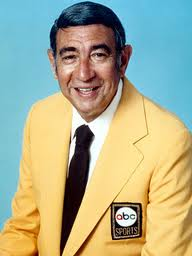
Howard Cosell: The Man, the Myth, and the Transformation of American Sports – As a kid, I couldn’t wait until the Halftime Highlights on Monday Night Football and begged my parents to let me stay up to watch. It wasn’t for the films. It was to hear Howard Cosell. Anyone who watched sports in the 1970s knows what hearing Cosell was like. If his private persona was anywhere near as interesting as his public one, then this will be a good book. Unfortunately, it is a hardback and does not seem very convenient for the road.

Lions of the West: Heroes and Villains of the Westward Expansion – Obviously, this is a history book, but it also covers my area of research. Each chapter chronicles the life of a person important to expansion, and several of them are from Tennessee. I’m not a fan of all of them, but you don’t really have to like someone to read about them. It’s a hardback, so I don’t know.

Decisions. Decisions. Life is full of decisions.

Brought to You By the Number 1,000

12 Mar

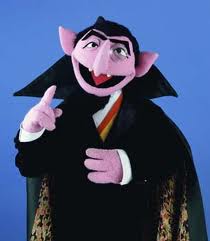
Over the weekend, the “Surrounded by Imbeciles” world hit another historic milestone – 1,000 page views. It took a while, but four figures was finally hit. As has been done with past milestones, I will mark the occasion with a celebration of the number 1,000. To assist in this endeavor, I will bring in my old friend, Count von Count.

Me: Count, make the introduction.

Count: Without further adieu, I present to you the number 1,000 HA HA HA HA!

1,000 Meters – the length of the course for women’s Olympic rowing events. For us non-metric Americans, this equals .6 miles.

1,000 AD – Hungary was established as a Christian state; Leif Ericson became the first European to land in North America; the Aztec migrate to Tenochtitlan, which will become one of the world’s largest cities; Oslo, Norway is supposedly founded; gunpowder is invented in China; and Abu Rayhan al-Biruni publishes The Book of Healing.

$1,000 Bill – With Grover Cleveland depicted on the front, this bill, along with other large denominations, was taken out of circulation in 1969. It is estimated that 165,372 remain in private hands. One of the largest collections can be seen at the Birdcage Theater in Tombstone, Arizona (the same Tombstone that saw the Gunfight at the OK Corral).

1,000 Meere – Performed by Tokio Hotel, this song is about long distance love and the struggles that come along with it.

1,00o Places to See Before You Die – The travelogue with the cool title has become a popular phenomenon. I haven’t read the book, but I have skimmed the Table of Contents to see how many of the places I have been. I have a long way to go with the world version but have taken a good chunk out of the American one.

Land of a Thousand Dances – Written and first recorded by Chris Kenner, the song busted out when it was recorded by Wilson Pickett. Despite the title, the original version mentions sixteen dances, including the Pony, the Chicken, the Tango and the Popeye.

Thousand Island Dressing – I have to admit that this is my favorite. I can eat this stuff on anything. Stories of its creation vary, but most believe it is named for the number of islands between the United States and Canada in the St. Lawrence River. It can include a lot of ingredients but always has mayonnaise.

A Thousand Faces – Ok, this is a little publicity for a cool store in Nashville. Located in Hillsboro Village, one of my favorite areas, it is filled with different kinds of art and, as the website says, “a plethora of neat stuff”.

1,000 BC – The world’s population is estimated to be 50,000,000; the Assyrians began an era of expansion; ancient Iranians first enter Persia; and Priene, in western Turkey, is founded.

So goes my ode to the number 1,000. I am sure there are more interesting facts out there, but I must admit that finding them was tougher than I first imagined. Next time, I am going to have to put Count von Count to better use.

It’s a Conspiracy

4 Mar

This semester, one of my fellow history teachers is offering a cool class on conspiracies in American history. I wish I could sit in on the course because he covers conspiracies from different eras and explains why people have been attracted to the theories during those times. It is interesting to hear his students talk about the subjects they cover in class and the assignments that he gives them. I can tell that they are having a lot of fun and learning along the way.

A few days ago, a couple of students were in my office talking and explained that each of them have been given a specific conspiracy to research and write about. As one talked about their assignment, I said that I had been there. Then, the other one talked about their assignment, and I have been there as well. Finally, one of them said that I must be the one behind all of the secrets because my travels have made me a common denominator. We laughed, but I began to think, “Damn, I have been to a lot of these places.”

With that in mind, here is a list of the places I have been lucky enough to visit that are connected to some vast conspiracy.

Cape Canaveral – One of the coolest tours anywhere, you can get a upclose view of the launch pads used from the 50s to the present. It is amazing to take a journey through the technological changes. What makes this prime conspiracy territory? Ask any moon landing skeptic, and they will tell you that these launches didn’t go anywhere. The astronauts were walking around somewhere in the desert.

Mount Rushmore – Actually, I didn’t know a conspiracy surrounded this monument until I watched an episode of Brad Meltzer’s Decoded. I thought the only conspiracy involving this place was by the people who made that stupid National Treasure: Book of Secrets movie. However, Meltzer’s minions looked into the possibility of the mount paying homage to racial purity. I don’t know about that, but I know that the Black Hills were the sacred land of the Sioux. The fact that it is now a tourist trap is conspiracy enough.

Roswell – In 1947, a UFO crashed near this New Mexico town, and the government has been covering up the incident ever since. It must be true because there is a museum dedicated to it with a lot of cool exhibits.

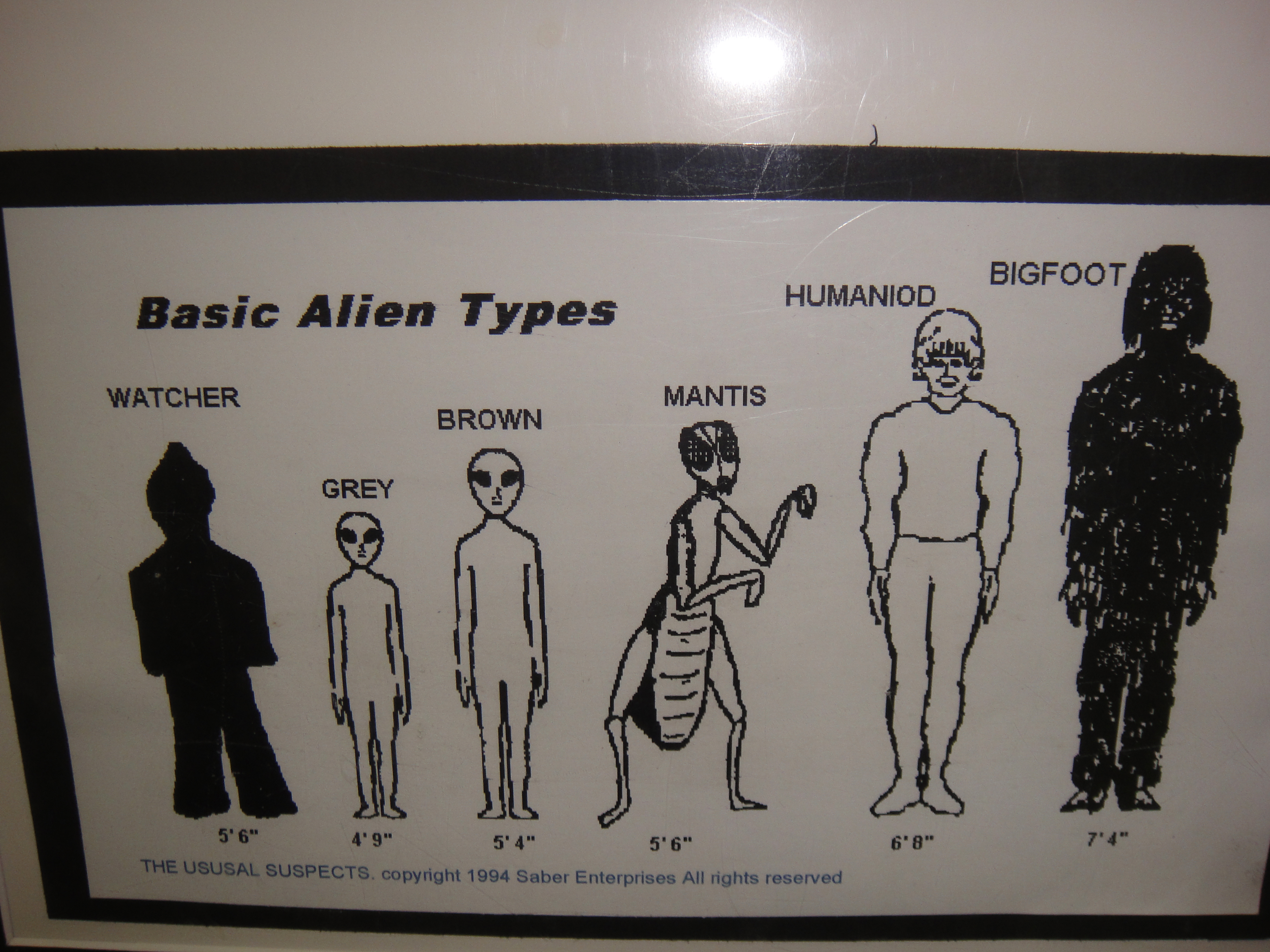
What? You didn’t know Bigfoot is an alien?

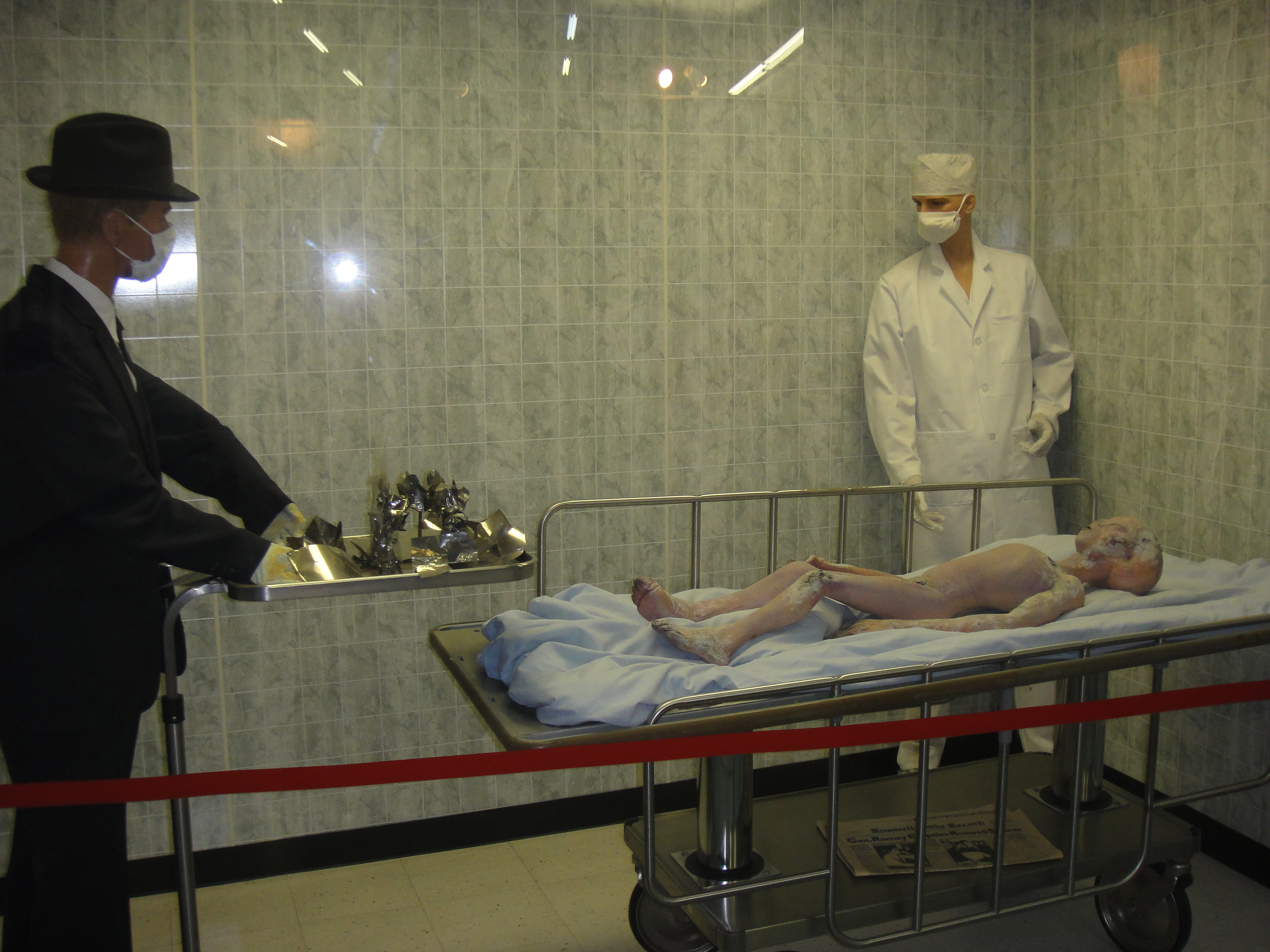
Then, you probably didn’t know that they have real recreations of alien autopsies.

Actually, the museum is interesting and has an extensive collection of UFO videos, research and writings.

Memphis – I wrote in a recent post about my visit to the National Civil Rights Museum, built on the site of Martin Luther King, Jr.’s assassination.

This conspiracy springs from the idea that a petty criminal like James Earl Ray could not have shot King and escaped to Europe without help. Ray fed this idea with his insistence that he was working with a man named Raoul. I have also wondered how Ray got away but had my questions answered after reading Hellhound on His Trail: The Stalking of Martin Luther King, Jr. and the International Hunt for His Assassin.

Dallas – The granddaddy of all conspiracy theories is based around the assassination of John F. Kennedy at Dealy Plaza. Most people probably believe that Lee Harvey Oswald did not act alone. Some say it was the mafia. Others say it was the Cubans, the Russians, or even the vice president. I don’t know about any of that, but I believe this conspiracy lingers for a couple of reasons.

First, a president, Abraham Lincoln, was actually the victim of a conspiracy.

Second, a visit to Dealy Plaza leads people to believe that something else must have happened. Walking around the grounds, it just makes sense that the gunman was on the grassy knoll and not in a window on an upper floor of a building. It is difficult to describe the area, but everyone should take a look for themselves. I must admit that of all the conspiracies this is the one I come closest to believing.

There you have it. The list of conspiratorial places that I have visited. I promise that this doesn’t make me the Cigarette-Smoking Man from The X-Files. Where’s my proof? If I was, then the following would happen.

Derek Dooley would resign as the head football coach at Tennessee, and the team would never lose another game.

I would win the lottery.

People would be breaking the law when they throw chewing gum on the ground.

I would win every hand of Blackjack.

All of us bloggers would be world-famous.

Questions that Keep Me Up at Night

1 Feb

What did Billy Joe McAllister throw off the Tallahatchie Bridge?

Why does Goofy talk, wear clothes and stand upright while Pluto does none of those?

What are the reindeer games?

Who’s afraid of Virginia Woolf?

What happened to the Lost Colony of Roanoke?

Who is Tom Doniphon?

What rhymes with orange?

Who’s “so vain”?

What happened to Jimmy Hoffa?

Is there a God?

Where’s Waldo?

If “Star Wars” is the past and “Star Trek” is the future, then what “star” is the present?

What happened to the people on the Mary Celeste?

Who has more money – Richie Rich or Bruce Wayne?

What’s in the case that everyone is after in “Ronin”?

Where in the world is Carmen Santiago?

What happened to D.B. Cooper?

Should I stay, or should I go?

Does the top fall at the end of “Inception”?

Which is better – “Speed Racer” or “Star Blazers”?

What does ke-mo sah-bee mean?

Will Wile E. Coyote ever catch the Roadrunner?

What the cooler superpower – invisibility or x-ray vision?

Who is Wilhelm, and why do movies keep using his scream?

Why do people who believe in reincarnation always claim to have been a famous person?

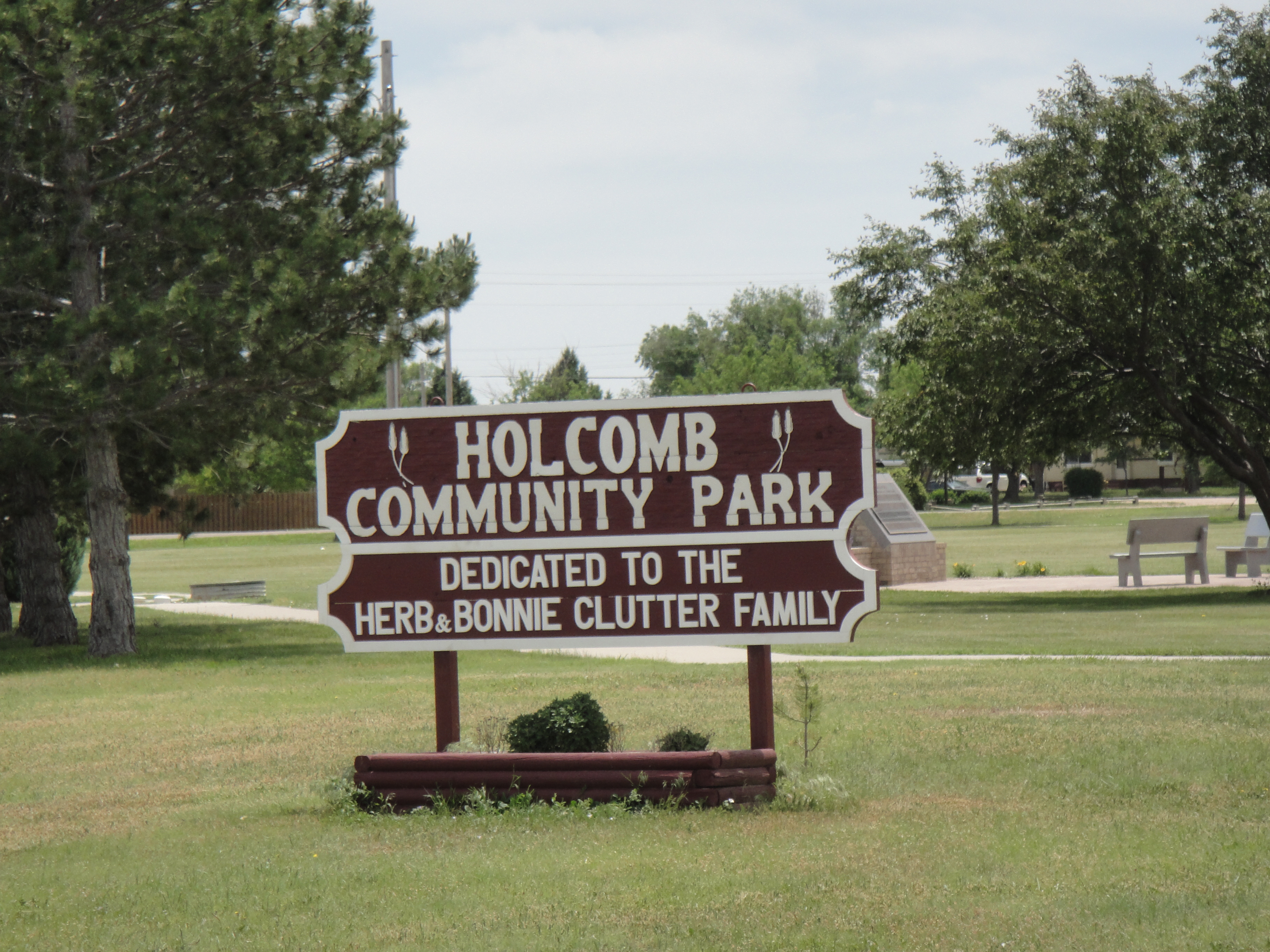
Picture This – Holcomb Community Park

31 Jan

Cities all over the country have parks dedicated in the honor of local citizens, and many of them have the same attributes as this one – benches, trees, walking trail and plenty of grass for picnics. Compared to other parks, this one is small, as it sits in a triangle of crossing streets. It is as if the small town of Holcomb, Kansas needed to do something with land that had been cut off from use and thought a small greenway would be a perfect solution.

However, this park does not honor a founding family or a local politician. It is dedicated to the family of Herb and Bonnie Clutter, which was slaughtered when their home was invaded by robbers in 1959. Tragedies such as this happen in cities all over the nation as well, and as years pass those incidents, also tragically, fade from the memories of those communities. In today’s world, we seem to be desensitized to the violence that happens around us. Bridges are named for fallen soldiers, but we hardly think about them as we pass by the signs. There may be other parks honoring murder victims, but they must be few and far between. So, why did the citizens of Holcomb build a park in honor of the Holcomb’s? Because several years after the attack, the murder in rural Kansas became known to people throughout the world.

After reading a newspaper article about the crime. Truman Capote became mesmerized by the story. He convinced Harper Lee, his childhood friend, to travel to Holcomb and investigate the murder. The result was “In Cold Blood”, a book that many believe began the “True Crime” genre. The writing of the book and the book itself have also been the subject of several movies. In my opinion, the work of Capote and his role in the overall story has come to overshadow the actual crime. As I drove around the small town and walked around the park, I did not think of the Holcomb’s or the men who were convicted of their murders. The question that kept running through my mind was:

Truman Capote came here?

The few people I saw stared at my rental car with the Tennessee tags and gave me the “what are you doing here?” look. And, I am sure they are used to a few people stopping by because of the town’s notoriety. I can’t imagine the reaction of the citizens of 1959 Holcomb when Truman Capote – he of the high society and fashionable side of New York City – arrived with his peculiarities. Likewise, I can’t imagine Capote’s thoughts when he arrived in a little town surrounded by nothing but flat plains. A more odd meeting of cultures is difficult to think about.

Despite of the strangeness of it all, or maybe because of it, I suggest a stop by the park to anyone who finds themself in the vicinity of Holcomb. Take a stroll around the walking trail or sit on a bench and take yourself back to 1959. Picture Capote and Lee hanging around town and interviewing people. Think about the reaction of the authorities when the pair walk in and start asking questions. And, imagine the journey that the writers took to dig deeper into a newspaper story. However, do not forget the Clutter family; the crime that struck down parents and two children; and the two other children left to live with the pain and the constant, best-selling reminder of the horror of their lives.

The Smell of Cape Jasmine

23 Jan

As a historian, I have never been interested in studying the past of my region, the South. I have heard about the Civil War and other aspects of its history all of my life and never really wanted to go behind the scenes of the stories and anecdotes of my childhood. However, this does not mean that I have turned my back on the South. As written in other posts, I have traveled throughout the United States, but I have never considered living anywhere but here. It is my home and everything that is associated with that word. Family. Friends. Familiarity. The “Three F’s” I suppose. I study the West, but I am a child of the South. But, like many others, I am not sure what it means to be a southerner.

Does it mean that I should be ashamed of a heritage of slavery and rebellion? Or, does it mean that I should be proud of a heritage of southern Founding Fathers like Washington and Jefferson? Does it mean that I should be proud of being raised in the Bible Belt? Or, does it mean I should be ashamed to be a native of a region that still argues over teaching the theory of evolution? Before answering those questions, I should explain what being a southerner is all about (at least for me).

It is eating black eyes peas and hog jaw on New Year’s Day for good luck.

It is going to college football games on Saturday’s in the fall.

It is visiting family on Sunday afternoon.

It is watching “Smokey and the Bandit” and realizing that you know a sheriff just like that.

It is going for a ride on a country road.

It is pulling over to pay respects to a passing funeral procession.

It is saying hello to a stranger that you pass on a sidewalk.

It is having a meal of fried chicken and turnip greens.

It is going to the National Walking Horse Celebration and wondering why the federal government won’t leave them alone.

It is being baptized when you are eleven years old because that’s what you are supposed to do.

It is wishing that people in other parts of the country would understand that you are not stupid because you talk differently.

It is thinking that people in New England talk funny.

It is being proud that Blues, Country, Rock ‘n Roll, Southern Rock, Bluegrass, Gospel and just about every other genre of music came from the South.

It is knowing that not all southerners would make this same list because we all don’t fit into the southern stereotype.

Notice that the list does not include driving a pickup truck; hunting or fishing; flying a rebel flag; drinking beer in a field; being a racist; having no teeth or shoes; or handling snakes in church. Of course, there are people who fit those descriptions. Just like there are people all over the country that fit those descriptions (except for maybe the snake handling). I am proud to be from the South and accept its good and bad qualities, but I have never known how to explain that pride. Maybe this post has done it. If not, then I will finish by writing about a song that I have always liked. It is country (which is strange for me), but I feel a connection to it. I will try to explain why.

“Good Ole Boys Like Me” by Don Williams

When I was a kid, Uncle Remus he put me to bed

With a picture of Stonewall Jackson above my head.

Then daddy came in to kiss his little man

With gin on his breath and a Bible in his hand.

He talked about honor and things I should know.

Then, he’d stagger a little as he went out the door.

(Uncle Remus is a collection of stories that were passed down from the days of slavery. They are mostly fables and tales that teach lessons. However, they are racist in the way they present Uncle Remus, a docile African-American man. Disney made a movie based on the stories which has faced a racist backlash as time has passed. I never heard these stories when I was a kid, but I was told plenty of stories along the same lines, namely the story of Little Black Sambo. Despite this experience, I did not grow up to be a racist or a member of the Klan.)

(Stonewall Jackson was a Civil War hero for the confederacy. While most southerners did not have pictures of Civil War officers hanging in their houses, this line aims at the importance many southerners still place on that terrible time in our history. Southerners have tended to forget what the war was about and focus on the fact that the South lost. For generations, this created a sense of inferiority. Of course, the economic conditions didn’t help. I once read an article with the theory that the debacle of the Vietnam War did not affect the South as it did other parts of the nation because the South already knew how it felt not to win.)

(My dad does not drink, but he is very religious. He has been a deacon in the church and complains about why I don’t go. However, this line hits home because I still call him “daddy”. I saw George Carlin (my favorite comedian of all time) in concert, and he made fun of grown southern men using this word. It may be dumb, but we still do it. It is not a childish act but an act of respect. The gin and Bible part is very southern because both play an important role in southern society. Honor is also an important part of southern ideology and society. Heck, that was one of the arguments for the Civil War – the north was challenging southern honor. There is a reason that dueling was legal in the South longer that it was anywhere else. And, it is still important in the South. It isn’t polite to air your dirty laundry in public.)

I can still hear the soft southern winds in the live oak trees.

And those Williams boys, they still mean a lot to me –

Hank and Tennessee.

I guess we’re all gonna be what we’re gonna be.

So, what do you do with good ole boys like me?

(Live oak does not mean that the tree is not dead. This is an iconic tree throughout the South and is the state tree of Georgia. Any picture of an old plantation has live oak’s in it. There is a reason that Twelve Oaks is one of the plantations in “Gone With the Wind”. While this may be a natural symbol of the region, it actually has a varied geography – mountains, river bottoms, swamps, hills.)

(The Williams boys shows the variety that the South has offered to American culture. Hank Williams was a legend in the world of country music and a songwriting genius. Tragically, he drank to excess and died in his 20s, but his music continues to inspire musicians and singers. One of the great writers of the 20th Century, Tennessee Williams provided us with plays and literary works that delve into the psyche and soul. “The Glass Menagerie”. “A Streetcar Named Desire”. “Cat on a Hot Tin Roof”. The list goes on and on. The South may have produced rednecks, but it also produced artistic geniuses. These are but two.)

And nothing makes a sound in the night like the wind does.

But you ain’t afraid if you’re washed in the blood like I was.

The smell of cape jasmine through the window screen.

John R. and the Wolfman kept me company

By the light of the radio by my bed

With Thomas Wolfe whispering in my head.

(The wind is blowing now, and it is one of my favorite sounds. However, that is not a southern thing. Being washed in the blood is. Baptism is a rite of passage in this part of the world. It is something that everyone I know was expected to go through. Each denomination has a different way of doing things, but most have similarities. At the end of the church service, the preacher asks for those who want to accept Christ to come to the front. If you feel the spirit, then you go to the front. Once the singing stops, the preachers announces to the congregation that you have made a decision to join the church and asks them to affirm it. At some point, you are baptized. In my church, this meant a full immersion under water. There you go – afterlife insurance. I joined at 11. My dad joined at 5. Neither one of us knew what we were doing, but we were saved nonetheless.)

(Cape Jasmine is a white flower known for its fragrance. It is called Cape because people thought it came from the Cape of Good Hope. It actually originated in Asia. There are all sorts of flowers and plants throughout the South due to the warm climate. Some, such as the Cape Jasmine, have brought beauty and an air of social standing. Lots of flower clubs exist around here for the uppity women of the South. This is probably left over from the days of plantations that fancied themselves as cousins of British aristocracy. Other plants, like cotton and tobacco have brought fortune but also infamy.)

(John R. and the Wolfman are my favorite names in this song. John R. was a Nashville legend as lead disc jockey on WLAC-AM, a clear channel station that reached 28 states. He played rhythm and blues and introduced southern African-American performers to listeners throughout his range. John R. became so popular with African-American audiences that they thought he was African-American as well. Wolfman Jack was a more famous disc jockey and gained this fame on the most powerful signal in North America, XERF-AM out of Ciudad Acuna, Mexico.)

(Thomas Wolfe, from Asheville, North Carolina, was a great southern novelist. I believe he is referenced in this song for his 1940 work, “You Can’t Go Home Again”. Once you have grown and left your surroundings, you can never go by to that “idyllic” lifestyle again. I put idyllic in quotations because once we look back we realize that it was never as good as we imagined. People often talk of the good old days, but they were never that good. Southerners, especially of the white variety, may think times were simpler then, but were they really? Segregation. No air conditioning. Many without electricity. Few well-paying jobs to be found. A great distance between the wealthy and the non-wealthy, both white and black. We can go home again physically, but we can never return intellectually and emotionally.)

When I was a kid I ran with a kid down the street,

And I watched him burn himself up on bourbon and speed.

But, I was smarter than most, and I could choose.

Learned to talk like the man on the six o’clock news.

When I was eighteen lord, I hit the road,

But it really doesn’t matter how far I go.

(Much of this song is more appropriate for the experiences of generations before mine. However, this part remains true to today. Several of the people I grew up with and played with as a child have become town drunks that waste their time in the bars a beer joints around town. I realize this happens all over the world, but I know that they never had aspirations of becoming the “town drunk”. Unlike the song, I didn’t leave. I found opportunity in the area and went with it. That makes me lucky. But, it makes me sad to see people with the same opportunity go down another path.)

So, what was this post? I am not sure myself. It is a defense of a region and a critique of the same region. Maybe it’s like family. I can talk about them all day long, but I’ll defend them if someone else says the same. That’s what being from the South is like. We can talk about each other and realize that we have issues. But, other people had better not join the discussion. Now that I think about it, that’s probably what the people who seceded from the country thought too.

The post is also an excuse to analyze one of my favorite songs (even though it’s country). So, if you made it this far I hope that you learned something. I learned that some questions don’t have answers. So, what do you do with good ole boys like me?

Kindling – Part 2

21 Jan

Yesterday, I decided to filter through my Kindle archive and blog about the works I found in there. You can skim that posting to discover my motivation behind this action and to read about some of the books hibernating in the archive. Unfortunately, the post took me too close to the morning hours, and I had to set my computer aside. This post covers the rest of the stories (to paraphrase Paul Harvey).

1. “End Game: Bobby Fischer’s Remarkable Rise and Fall – from America’s Brightest Prodigy to the Edge of Madness” by Frank Brady – When I was a kid, I was fascinated by Bobby Fischer. However, it wasn’t the chess. It was the fact that he disappeared. For some reason, I liked the people who fell off the face of the earth, such as Fischer and Howard Hughes. I started this book hoping that it would shed some light on that part of his life. To my dismay, it skimmed over the “mystery” because there was none. People knew where he was. He didn’t disappear. He just stopped playing chess. Despite that disappointment, this is an interesting journey into a mind that is slowly going mad. At the end, I thought I was crazy.

2. “Holy Blood, Holy Grail” by Michael Baigent, Richard Leigh and Henry Lincoln – Who doesn’t like a good conspiracy? And this is the king daddy of them all. Get that – king daddy…Jesus had a kid. Yeah, kinda corny I suppose. Anyway, this is the book that inspired “The Da Vinci Code”. The writers delve into all sorts of history to come up with the theory of a holy bloodline that continues to flow. It is terribly written and terribly researched. But, that isn’t the point. If you don’t believe man landed on the moon and believe the world is going to end on December 21, 2012, then this is the book for you. I love conspiracies, so I loved the read.

3. “The Hunger Games” and “Mockingjay” by Suzanne Collins – I read the physical version of the other book. I reckon that grown men shouldn’t be reading YA novels about young girls. However, this young girl kicks ass. Almost everybody knows about this series, so I won’t go into a big explanation. It’s super cool, and I hope the movies are super cooler.

4. “Robopocalypse” by Daniel Wilson – It’s been done more than once. “I, Robot”. “Maximum Overdrive”. Machines come to life and take over the world. We seem to fear a takeover by the things that we believe we control. Machines and animals in particular. However, this is a great book that takes us around the world as survivors try to fight back. Despite their struggle, I can’t help but like the machine that is controlling the entire process. It accomplished where numerous humans have failed. It conquered the world.

5. “World War Z” by Max Brooks – Zombies are misunderstood. When did voodoo get taken out of the zombie story and disease take its place? Of all the zombie books, this one is my favorite because it reads like a real history. Interviews such as this have been done by real researchers talking to real veterans, and the stories are similar to reality. Well, except for the enemy that just won’t die. I can’t say enough about this book. It spans the globe and traces the history of a war that seemed impossible to win. It is becoming a movie, but I can’t see how they can fit this into a two-hour time slot. It will be interesting to watch, but I think the movie in my mind will have to suffice.

6. “When Pride Still Mattered: A Life of Vince Lombardi” by David Maraniss – In history, we tend to view the participants as two-dimensional beings. Good or bad. Hero or villain. Strong or weak. As the years pass, their humanity turns into statues of stone or metal. Vince Lombardi provides the perfect example. He is a winner – the greatest football coach ever. The Super Bowl trophy is named after him. This biography goes past the images and words of NFL Films to show a man who had fears, doubts and problems at home. He was a great coach but a terrible father. He was a saint but a tyrant. In short, he was human.

There you have it. That cleans out my digital archive. As it turns out, this was a lot easier than loading boxes with hundreds of pounds of books. Now, I just have to start reading the long list of books that I haven’t gotten to yet.

Kindling

20 Jan

A couple of Christmas’ ago, I was surprised to be given an iPad. It had never been something that I talked about, and I didn’t realize that the person who gave it like me that much. I don’t use the iPad very much to serve the internet because I find a laptop much easier to type on a read. However, I use the iPad to play games and read on the Kindle. This Kindle thing was a surprise to me as well. I was always one of those people who talked about how I was never going to give in to the technology. I like holding a book and turning the pages. I like spending hours in bookstores. However, it wasn’t long before those opinions started to change. Of course, I still like bookstores. Who doesn’t? But, I have now become one of those people who is killing the bookstores. Instead of buying books, I get titles and download them later. It’s terrible, I know. It feels like cheating.

I was thinking about this change of opinion while sitting in my office this afternoon. Bunches of books were taking up space, and I began thinking about how I needed to clean out my shelves. My office is nothing like my house. There are books on shelves, crammed in drawers, and places anywhere they might be considered out-of-the-way. Some of them were memorable. Some of them have were forgotten as soon as the last word was read. but, most are waiting in the queue to be opened before they are lost in the Land of Closed Drawers.

I hate getting rid of books. It takes a lot of effort, both physical and mental. Figuring out which ones go and which ones stay. Picking up a totally overloaded box. coming up with a place to take the overloaded box. Hoping that the books find good, caring homes. Thinking about all of that trouble made me appreciate the Kindle in another way. When a book is finished, I just place my finger on it until it shakes and “x” it into the archives. No shelves. No drawers. No boxes. Just a button.

With that in mind, I decided to look through the Kindle archives and see what I have filled my mind with.

1. “The American West” by Dee Brown – This semester I am teaching the Expansion of the United States and read this work to brush up on the history of that time and place. Brown is a famous writer of the American West, but he is not a true historian. He  falls into the category of popular historian that academic historians love to complain about. The latter does the research while the former gets the fame. Actually, there are a lot of good “popular” writers. Unfortunately, Brown is not one of them. The book is badly arranged and needs an editor badly. He knows a lot of good information and tells great stories. However, it took an effort to get through it, and I love this stuff.

2. “The Big Scrum” by John J. Miller – This book chronicles the early days of college football and how it was saved by Theodore Roosevelt. At the turn of the 18th/19th Centuries, academic leaders were outraged at the sport taking over their campuses. Violence. Horrible injuries. Cheating. Paying players. Recruiting issues. It seemed that the game was going to drag universities into the gutter of professional sports. Before they could take action, TR and other leaders stepped up to claim that the game was good for America and the development of manhood. I am not sure about that, but I like college football. So, I’m glad they saved it.

3. “Blood of the Reich” by William Dietrich – Dietrich has written a series of novels about Ethan Gage, adventurer extraordinaire. His hero outwitted Napoleon; defeated Barbary pirates; and survived adventures in the unexplored American West. In this book, new heroes fight Nazis, both old and new, to find a great power in Tibet. I didn’t like this as much as the Gage adventures. However, I don’t think it was the fault of Dietrich. Before this book, I read “Sleepwalkers” by a writer that I won’t name to save him from the embarrassment. It was about a Jewish detective looking into a horrible crime before Nazis took power in Germany. It was terrible. No character development. Telegraphing of plot. Jumped from scene to scene without any connection. The only good part was the prostitute that he spent a lot of time describing. Unfortunately, she disappeared without any explanation with what happened.

4. “The Devil Colony” by James Rollins – I really like the adventures of Grayson Pierce and the Sigma Force team. In this one, they head into the American West to stop a mysterious force from destroying the globe. They hit some places that I have been, so it was easy to visualize the action. Plus, they ended up in Yellowstone. How can you beat that?

5. “The Devil’s Gold” by Steve Berry – This is a Kindle-only short story used to st up the action in an upcoming novel. In short, an operative is looking for lost Nazi gold in South America. In the process, he finds the offspring of Adolf Hitler. Short story equal short description.

6. “The Jefferson Key” by Steve Berry – This is the novel set up by the previously mentioned short story. Cotton Malone goes after a secret cabal of pirates whose families have been protected by the United States government since its inception. It starts out with Andrew Jackson being himself and sticking to the pirate ancestors. Those of us in Tennessee know how Jackson was. He didn’t take any shit. Well, the pirate descendants are figuring out a way to get out of the situation Old Hickory put them in. Malone has to stop them.

7. “Evel: The High-Flying Life of Evel Knievel: American Showman, Daredevil, and Legend” by Leigh Montville – As a kid, I was fascinated by Evel Knievel. I watched the jumps; had the toys; and wanted to be just like him. This is an all-encompassing biography that follows Evel from his youth in Butte, Montana to his death as broken, both physically and financially, old man. In between were adventures that you would assume the world’s most famous daredevil would have. Women. Alcohol. Parties. All the trappings of decadence and fame. The surprise comes when it’s revealed that Evel was afraid of dying the entire time. He created a persona that he couldn’t escape. His job was facing death with the world watching and death was looking back.

That gets us halfway through the archives, and I have discovered that typing about the finished books is almost as tiresome as putting them in boxes. We will explore the next half in the next post.

A Historian’s Office

6 Jan

Two days of constant meetings have melted my mind, and the only sounds I can hear over the drone of voices are my brain cells screaming as they leap to their deaths. As I sit in my office in an attempt to recover, I  can’t think of anything clever or interesting to write about. Therefore, I am going to take the easy way out and describe what I see – my office.

My office has turned into a popular hangout on campus, and I sometimes describe it as the El Paso train station. People are always coming and going. Students and teachers drop by to visit on a regular basis, and they often comment on the things I have scattered about. Of course, that is once they get past the darkness of it all. I keep all lights off except for one desk lamp. I have been accused of being a vampire; of trying to be mysterious; and of being a cave-dweller. I usually reply that I do my best work in the dark, but the truth is that the bigger lights hurt my eyes. Whatever the complaints and smart comments, people must like my office because someone is always in it.

With that in mind, I am going to attempt this blog experiment to test my descriptive skills. I am going to sit at my desk and describe the things I can see. We will do this in categories.

Category 1 – Wall Hangings

As I look to my left, there are four things hanging on the wall.

1. An old print of a cattle drive that I stole out of one of the classrooms. The teacher in that room is a Native American, so I figured he didn’t want cowboys in there anyway. Two cowboys are riding hard to stop a stampede that began with a lightning storm.

2. A photograph of Ulysses S. Grant. It is an iconic photo of the general as he leans against a tree. The best part is his original signature that is matted underneath.

3. A collection of Confederate money. There are six Confederate bills – One, Two, Five, Ten, Twenty, Fifty – matted and framed. There are a lot of Sons of Confederate Veterans members around here who wish the money was still good.

4. A photograph of Adolph Hitler and a Nazi arm band. It is a typical picture of the tyrant in civilian clothes. Like the photo of Grant, the most interesting part of this item is the document included with his original signature. I explain to everyone that I am not a Nazi. I simply think it is a remarkable piece of history.

Now, I move to the wall in front of me.

1. Above the door, there hangs a panoramic of the Tennessee Maneuvers. When the U.S. entered World War II, the military believed that troops needed to be seasoned with war games before going to Europe. Tennessee is geographically similar to where they were going, and the area was selected for that purpose. My university was chosen as the headquarters, as troops fought battles; liberated cities; and built bridges across rivers.

2. A plaque given to me after serving as honorary coach for our men’s basketball team. It was a resounding victory.

3. A plaque given to me in recognition for serving on the community council of a local bank.

4. A plaque given to me as the “Most Outstanding Faculty Member” for last year. I was proud of this because I beat my mentor before he retired. He had won the award a million years in a row.

5. A certificate honoring me as a Colonel Aide de Camp for the governor of Tennessee. They pass these things out like candy. It is the same certificate given to Harlan Sanders in Kentucky. He wasn’t a real colonel. He was  a fake one like me.

6. A drawing of the old county courthouse. It was consistently voted the ugliest courthouse in Tennessee and was demolished before I was born.

I hope this is not getting monotonous. On to the wall on my right.

1. My favorite plaque. It reads, “On This Site In 1897 Nothing Happened”. I got it at the Longwood Plantation in Natchez, Mississippi. Some of you may know it better as the home of the king of Mississippi in “True Blood”.

2. A license of prostitution given to Rosita del Oro in 1876. This probably attracts the males to my office because it is included with a photograph of a nude woman playing a harp.

3. The next item covers a lot of the wall. I took a lot of pictures of the Dumas Brothel when I researched it in Butte, Montana. Upon my return, I had a local artist paint a few of the photographs. This one depicts the interior of a crib, a one room shack that prostitutes would work out of. A woman is sitting by the window in an attempt to draw customers. I will blog more later about the women of the cribs.

Finally, the wall behind me.

1. Another painting of the Dumas depicts the outside of the building. It is a two-story brick building that the artist placed in a Victorian setting. I am not real happy about the woman in the window. She looks a lot like Morticia Addams.

Category 2 – Filing Cabinet Decor

1. A magnetic fish with legs and Darwin written inside of it. I picked it up in Santa Fe and have to hide it when my parents come around.

2. A sticker of George Washington with a dialogue bubble that says, “I grew hemp.” I believe he was the largest producer in the colonies.

3. A magnetic voodoo doll that I bought in New Orleans. I haven’t tried it out yet, but people better watch out.

4. A bumper sticker with an alien on it that says, “You Don’t Scare Me. I’m A Teacher!” It came from the UFO Museum in Roswell, New Mexico, one of the greatest museums ever.

5. On top of the cabinet sits an original World War I German helmet – the kind with the spike on top. They would jab it into the ground and use it as a cooking pot. They used it as another got of pot as well. You can use your imagination.

Category 3 – Bookshelf Without Books

Top shelf first.

1. A miniature of the Roman Coliseum. I got it in Rome.

2. A candle from the San Xavier del Bac in Tucson, Arizona. An ex-girlfriend got it for me, and I finally visited the site last year.

3. A model of the Mayflower, the boat filled with pilgrims searching for religious freedom. Ugh. The real story of the Mayflower is a lot more interesting.

4. Two bobbleheads. One is a sheik wearing sunglasses. The other is a Muslim woman wearing an abaya. This is not an attempt at a political or religious statement. They were given to me by an ex-girlfriend who moved to the UAE. They sold them. She bought them. I displayed them.

Next shelf.

1. A textbook on Western Civilization. This is very outdated.

2. A book called, “Pauline’s: Memories of the Madam on Clay Street”. It was given to me by the university president and chronicles the life of a madam in Bowling Green, Kentucky.

3. Another book titled, “Life of Tom Horn”. He was a prominent figure in the cattle wars of Wyoming. Bad ending, they hung him.

4. And another book called, “Intimate Papers of Colonel House”. I have not read this. It is an old book gifted to me by a professor who passed away.

5. A little set of nuns and priests playing poker. This is from the same ex-girlfriend who gave the candle to me. These little guys came from Italy. I wouldn’t want to sit across the table from any one of them.

5. Along side those things is my Masters thesis about prostitution in mining camps of the American West. I don’t have much to say about this, except that I finished it.

The bottom shelf (I know. Thank God!)

1. A replica of a statue on campus. It was built to honor the laborers who built my building during the Great Depression. It is meant to symbolize the New Deal and other aspects of the era. Unfortunately, it is out of proportion and looks like a midget.

2. A brick from this building that was dislodged during renovation. It was originally laid in 1936 and looks like it.

3. A beer stein decorated with John Wayne pictures. I can’t help it. John Wayne is my all time favorite actor. Inside the stein, I placed glass sunflowers that a weird female student once gave me. Don’t ask.

I suppose this should end, but I can’t describe a historian’s office without listing a few books. We all have to have books. So, I will name the first book I see on each shelf.

Category 4 – Books

1. “Soiled Doves: Prostitution in the Early West” by Anne Seagraves

2. “The Pueblo Revolt of 1680: Conquest and Resistance in Seventeenth-Century New Mexico” by Andrew L. Knaut

3. “Parlor Politics: In Which the Ladies of Washington Help Build a City and a Government” by Catherine Allgor

4. “Authenticated History of the Bell Witch, and Other Stories of the World’s Greatest Unexplained Phenomenon” by M.V. Ingram

5. “Awash in a Sea of Faith: Christianizing the American People” by Jon Butler

6. “Mining Town: The Photographic Record of T.N. Barnard and Nellie Stockbridge from the Couer d’Alenes” by Patricia Hart and Ivar Nelson

Thankfully, that’s it. Oh, you may be wondering about my desk. Classes haven’t started yet, so there is nothing on it except sunglasses and a lamp.