
Tag Archives: History

The Smell of Cape Jasmine

23 Jan

As a historian, I have never been interested in studying the past of my region, the South. I have heard about the Civil War and other aspects of its history all of my life and never really wanted to go behind the scenes of the stories and anecdotes of my childhood. However, this does not mean that I have turned my back on the South. As written in other posts, I have traveled throughout the United States, but I have never considered living anywhere but here. It is my home and everything that is associated with that word. Family. Friends. Familiarity. The “Three F’s” I suppose. I study the West, but I am a child of the South. But, like many others, I am not sure what it means to be a southerner.

Does it mean that I should be ashamed of a heritage of slavery and rebellion? Or, does it mean that I should be proud of a heritage of southern Founding Fathers like Washington and Jefferson? Does it mean that I should be proud of being raised in the Bible Belt? Or, does it mean I should be ashamed to be a native of a region that still argues over teaching the theory of evolution? Before answering those questions, I should explain what being a southerner is all about (at least for me).

It is eating black eyes peas and hog jaw on New Year’s Day for good luck.

It is going to college football games on Saturday’s in the fall.

It is visiting family on Sunday afternoon.

It is watching “Smokey and the Bandit” and realizing that you know a sheriff just like that.

It is going for a ride on a country road.

It is pulling over to pay respects to a passing funeral procession.

It is saying hello to a stranger that you pass on a sidewalk.

It is having a meal of fried chicken and turnip greens.

It is going to the National Walking Horse Celebration and wondering why the federal government won’t leave them alone.

It is being baptized when you are eleven years old because that’s what you are supposed to do.

It is wishing that people in other parts of the country would understand that you are not stupid because you talk differently.

It is thinking that people in New England talk funny.

It is being proud that Blues, Country, Rock ‘n Roll, Southern Rock, Bluegrass, Gospel and just about every other genre of music came from the South.

It is knowing that not all southerners would make this same list because we all don’t fit into the southern stereotype.

Notice that the list does not include driving a pickup truck; hunting or fishing; flying a rebel flag; drinking beer in a field; being a racist; having no teeth or shoes; or handling snakes in church. Of course, there are people who fit those descriptions. Just like there are people all over the country that fit those descriptions (except for maybe the snake handling). I am proud to be from the South and accept its good and bad qualities, but I have never known how to explain that pride. Maybe this post has done it. If not, then I will finish by writing about a song that I have always liked. It is country (which is strange for me), but I feel a connection to it. I will try to explain why.

“Good Ole Boys Like Me” by Don Williams

When I was a kid, Uncle Remus he put me to bed

With a picture of Stonewall Jackson above my head.

Then daddy came in to kiss his little man

With gin on his breath and a Bible in his hand.

He talked about honor and things I should know.

Then, he’d stagger a little as he went out the door.

(Uncle Remus is a collection of stories that were passed down from the days of slavery. They are mostly fables and tales that teach lessons. However, they are racist in the way they present Uncle Remus, a docile African-American man. Disney made a movie based on the stories which has faced a racist backlash as time has passed. I never heard these stories when I was a kid, but I was told plenty of stories along the same lines, namely the story of Little Black Sambo. Despite this experience, I did not grow up to be a racist or a member of the Klan.)

(Stonewall Jackson was a Civil War hero for the confederacy. While most southerners did not have pictures of Civil War officers hanging in their houses, this line aims at the importance many southerners still place on that terrible time in our history. Southerners have tended to forget what the war was about and focus on the fact that the South lost. For generations, this created a sense of inferiority. Of course, the economic conditions didn’t help. I once read an article with the theory that the debacle of the Vietnam War did not affect the South as it did other parts of the nation because the South already knew how it felt not to win.)

(My dad does not drink, but he is very religious. He has been a deacon in the church and complains about why I don’t go. However, this line hits home because I still call him “daddy”. I saw George Carlin (my favorite comedian of all time) in concert, and he made fun of grown southern men using this word. It may be dumb, but we still do it. It is not a childish act but an act of respect. The gin and Bible part is very southern because both play an important role in southern society. Honor is also an important part of southern ideology and society. Heck, that was one of the arguments for the Civil War – the north was challenging southern honor. There is a reason that dueling was legal in the South longer that it was anywhere else. And, it is still important in the South. It isn’t polite to air your dirty laundry in public.)

I can still hear the soft southern winds in the live oak trees.

And those Williams boys, they still mean a lot to me –

Hank and Tennessee.

I guess we’re all gonna be what we’re gonna be.

So, what do you do with good ole boys like me?

(Live oak does not mean that the tree is not dead. This is an iconic tree throughout the South and is the state tree of Georgia. Any picture of an old plantation has live oak’s in it. There is a reason that Twelve Oaks is one of the plantations in “Gone With the Wind”. While this may be a natural symbol of the region, it actually has a varied geography – mountains, river bottoms, swamps, hills.)

(The Williams boys shows the variety that the South has offered to American culture. Hank Williams was a legend in the world of country music and a songwriting genius. Tragically, he drank to excess and died in his 20s, but his music continues to inspire musicians and singers. One of the great writers of the 20th Century, Tennessee Williams provided us with plays and literary works that delve into the psyche and soul. “The Glass Menagerie”. “A Streetcar Named Desire”. “Cat on a Hot Tin Roof”. The list goes on and on. The South may have produced rednecks, but it also produced artistic geniuses. These are but two.)

And nothing makes a sound in the night like the wind does.

But you ain’t afraid if you’re washed in the blood like I was.

The smell of cape jasmine through the window screen.

John R. and the Wolfman kept me company

By the light of the radio by my bed

With Thomas Wolfe whispering in my head.

(The wind is blowing now, and it is one of my favorite sounds. However, that is not a southern thing. Being washed in the blood is. Baptism is a rite of passage in this part of the world. It is something that everyone I know was expected to go through. Each denomination has a different way of doing things, but most have similarities. At the end of the church service, the preacher asks for those who want to accept Christ to come to the front. If you feel the spirit, then you go to the front. Once the singing stops, the preachers announces to the congregation that you have made a decision to join the church and asks them to affirm it. At some point, you are baptized. In my church, this meant a full immersion under water. There you go – afterlife insurance. I joined at 11. My dad joined at 5. Neither one of us knew what we were doing, but we were saved nonetheless.)

(Cape Jasmine is a white flower known for its fragrance. It is called Cape because people thought it came from the Cape of Good Hope. It actually originated in Asia. There are all sorts of flowers and plants throughout the South due to the warm climate. Some, such as the Cape Jasmine, have brought beauty and an air of social standing. Lots of flower clubs exist around here for the uppity women of the South. This is probably left over from the days of plantations that fancied themselves as cousins of British aristocracy. Other plants, like cotton and tobacco have brought fortune but also infamy.)

(John R. and the Wolfman are my favorite names in this song. John R. was a Nashville legend as lead disc jockey on WLAC-AM, a clear channel station that reached 28 states. He played rhythm and blues and introduced southern African-American performers to listeners throughout his range. John R. became so popular with African-American audiences that they thought he was African-American as well. Wolfman Jack was a more famous disc jockey and gained this fame on the most powerful signal in North America, XERF-AM out of Ciudad Acuna, Mexico.)

(Thomas Wolfe, from Asheville, North Carolina, was a great southern novelist. I believe he is referenced in this song for his 1940 work, “You Can’t Go Home Again”. Once you have grown and left your surroundings, you can never go by to that “idyllic” lifestyle again. I put idyllic in quotations because once we look back we realize that it was never as good as we imagined. People often talk of the good old days, but they were never that good. Southerners, especially of the white variety, may think times were simpler then, but were they really? Segregation. No air conditioning. Many without electricity. Few well-paying jobs to be found. A great distance between the wealthy and the non-wealthy, both white and black. We can go home again physically, but we can never return intellectually and emotionally.)

When I was a kid I ran with a kid down the street,

And I watched him burn himself up on bourbon and speed.

But, I was smarter than most, and I could choose.

Learned to talk like the man on the six o’clock news.

When I was eighteen lord, I hit the road,

But it really doesn’t matter how far I go.

(Much of this song is more appropriate for the experiences of generations before mine. However, this part remains true to today. Several of the people I grew up with and played with as a child have become town drunks that waste their time in the bars a beer joints around town. I realize this happens all over the world, but I know that they never had aspirations of becoming the “town drunk”. Unlike the song, I didn’t leave. I found opportunity in the area and went with it. That makes me lucky. But, it makes me sad to see people with the same opportunity go down another path.)

So, what was this post? I am not sure myself. It is a defense of a region and a critique of the same region. Maybe it’s like family. I can talk about them all day long, but I’ll defend them if someone else says the same. That’s what being from the South is like. We can talk about each other and realize that we have issues. But, other people had better not join the discussion. Now that I think about it, that’s probably what the people who seceded from the country thought too.

The post is also an excuse to analyze one of my favorite songs (even though it’s country). So, if you made it this far I hope that you learned something. I learned that some questions don’t have answers. So, what do you do with good ole boys like me?
Kindling – Part 2

21 Jan

Yesterday, I decided to filter through my Kindle archive and blog about the works I found in there. You can skim that posting to discover my motivation behind this action and to read about some of the books hibernating in the archive. Unfortunately, the post took me too close to the morning hours, and I had to set my computer aside. This post covers the rest of the stories (to paraphrase Paul Harvey).

1. “End Game: Bobby Fischer’s Remarkable Rise and Fall – from America’s Brightest Prodigy to the Edge of Madness” by Frank Brady – When I was a kid, I was fascinated by Bobby Fischer. However, it wasn’t the chess. It was the fact that he disappeared. For some reason, I liked the people who fell off the face of the earth, such as Fischer and Howard Hughes. I started this book hoping that it would shed some light on that part of his life. To my dismay, it skimmed over the “mystery” because there was none. People knew where he was. He didn’t disappear. He just stopped playing chess. Despite that disappointment, this is an interesting journey into a mind that is slowly going mad. At the end, I thought I was crazy.

2. “Holy Blood, Holy Grail” by Michael Baigent, Richard Leigh and Henry Lincoln – Who doesn’t like a good conspiracy? And this is the king daddy of them all. Get that – king daddy…Jesus had a kid. Yeah, kinda corny I suppose. Anyway, this is the book that inspired “The Da Vinci Code”. The writers delve into all sorts of history to come up with the theory of a holy bloodline that continues to flow. It is terribly written and terribly researched. But, that isn’t the point. If you don’t believe man landed on the moon and believe the world is going to end on December 21, 2012, then this is the book for you. I love conspiracies, so I loved the read.

3. “The Hunger Games” and “Mockingjay” by Suzanne Collins – I read the physical version of the other book. I reckon that grown men shouldn’t be reading YA novels about young girls. However, this young girl kicks ass. Almost everybody knows about this series, so I won’t go into a big explanation. It’s super cool, and I hope the movies are super cooler.

4. “Robopocalypse” by Daniel Wilson – It’s been done more than once. “I, Robot”. “Maximum Overdrive”. Machines come to life and take over the world. We seem to fear a takeover by the things that we believe we control. Machines and animals in particular. However, this is a great book that takes us around the world as survivors try to fight back. Despite their struggle, I can’t help but like the machine that is controlling the entire process. It accomplished where numerous humans have failed. It conquered the world.

5. “World War Z” by Max Brooks – Zombies are misunderstood. When did voodoo get taken out of the zombie story and disease take its place? Of all the zombie books, this one is my favorite because it reads like a real history. Interviews such as this have been done by real researchers talking to real veterans, and the stories are similar to reality. Well, except for the enemy that just won’t die. I can’t say enough about this book. It spans the globe and traces the history of a war that seemed impossible to win. It is becoming a movie, but I can’t see how they can fit this into a two-hour time slot. It will be interesting to watch, but I think the movie in my mind will have to suffice.

6. “When Pride Still Mattered: A Life of Vince Lombardi” by David Maraniss – In history, we tend to view the participants as two-dimensional beings. Good or bad. Hero or villain. Strong or weak. As the years pass, their humanity turns into statues of stone or metal. Vince Lombardi provides the perfect example. He is a winner – the greatest football coach ever. The Super Bowl trophy is named after him. This biography goes past the images and words of NFL Films to show a man who had fears, doubts and problems at home. He was a great coach but a terrible father. He was a saint but a tyrant. In short, he was human.

There you have it. That cleans out my digital archive. As it turns out, this was a lot easier than loading boxes with hundreds of pounds of books. Now, I just have to start reading the long list of books that I haven’t gotten to yet.

Kindling

20 Jan

A couple of Christmas’ ago, I was surprised to be given an iPad. It had never been something that I talked about, and I didn’t realize that the person who gave it like me that much. I don’t use the iPad very much to serve the internet because I find a laptop much easier to type on a read. However, I use the iPad to play games and read on the Kindle. This Kindle thing was a surprise to me as well. I was always one of those people who talked about how I was never going to give in to the technology. I like holding a book and turning the pages. I like spending hours in bookstores. However, it wasn’t long before those opinions started to change. Of course, I still like bookstores. Who doesn’t? But, I have now become one of those people who is killing the bookstores. Instead of buying books, I get titles and download them later. It’s terrible, I know. It feels like cheating.

I was thinking about this change of opinion while sitting in my office this afternoon. Bunches of books were taking up space, and I began thinking about how I needed to clean out my shelves. My office is nothing like my house. There are books on shelves, crammed in drawers, and places anywhere they might be considered out-of-the-way. Some of them were memorable. Some of them have were forgotten as soon as the last word was read. but, most are waiting in the queue to be opened before they are lost in the Land of Closed Drawers.

I hate getting rid of books. It takes a lot of effort, both physical and mental. Figuring out which ones go and which ones stay. Picking up a totally overloaded box. coming up with a place to take the overloaded box. Hoping that the books find good, caring homes. Thinking about all of that trouble made me appreciate the Kindle in another way. When a book is finished, I just place my finger on it until it shakes and “x” it into the archives. No shelves. No drawers. No boxes. Just a button.

With that in mind, I decided to look through the Kindle archives and see what I have filled my mind with.

1. “The American West” by Dee Brown – This semester I am teaching the Expansion of the United States and read this work to brush up on the history of that time and place. Brown is a famous writer of the American West, but he is not a true historian. He  falls into the category of popular historian that academic historians love to complain about. The latter does the research while the former gets the fame. Actually, there are a lot of good “popular” writers. Unfortunately, Brown is not one of them. The book is badly arranged and needs an editor badly. He knows a lot of good information and tells great stories. However, it took an effort to get through it, and I love this stuff.

2. “The Big Scrum” by John J. Miller – This book chronicles the early days of college football and how it was saved by Theodore Roosevelt. At the turn of the 18th/19th Centuries, academic leaders were outraged at the sport taking over their campuses. Violence. Horrible injuries. Cheating. Paying players. Recruiting issues. It seemed that the game was going to drag universities into the gutter of professional sports. Before they could take action, TR and other leaders stepped up to claim that the game was good for America and the development of manhood. I am not sure about that, but I like college football. So, I’m glad they saved it.

3. “Blood of the Reich” by William Dietrich – Dietrich has written a series of novels about Ethan Gage, adventurer extraordinaire. His hero outwitted Napoleon; defeated Barbary pirates; and survived adventures in the unexplored American West. In this book, new heroes fight Nazis, both old and new, to find a great power in Tibet. I didn’t like this as much as the Gage adventures. However, I don’t think it was the fault of Dietrich. Before this book, I read “Sleepwalkers” by a writer that I won’t name to save him from the embarrassment. It was about a Jewish detective looking into a horrible crime before Nazis took power in Germany. It was terrible. No character development. Telegraphing of plot. Jumped from scene to scene without any connection. The only good part was the prostitute that he spent a lot of time describing. Unfortunately, she disappeared without any explanation with what happened.

4. “The Devil Colony” by James Rollins – I really like the adventures of Grayson Pierce and the Sigma Force team. In this one, they head into the American West to stop a mysterious force from destroying the globe. They hit some places that I have been, so it was easy to visualize the action. Plus, they ended up in Yellowstone. How can you beat that?

5. “The Devil’s Gold” by Steve Berry – This is a Kindle-only short story used to st up the action in an upcoming novel. In short, an operative is looking for lost Nazi gold in South America. In the process, he finds the offspring of Adolf Hitler. Short story equal short description.

6. “The Jefferson Key” by Steve Berry – This is the novel set up by the previously mentioned short story. Cotton Malone goes after a secret cabal of pirates whose families have been protected by the United States government since its inception. It starts out with Andrew Jackson being himself and sticking to the pirate ancestors. Those of us in Tennessee know how Jackson was. He didn’t take any shit. Well, the pirate descendants are figuring out a way to get out of the situation Old Hickory put them in. Malone has to stop them.

7. “Evel: The High-Flying Life of Evel Knievel: American Showman, Daredevil, and Legend” by Leigh Montville – As a kid, I was fascinated by Evel Knievel. I watched the jumps; had the toys; and wanted to be just like him. This is an all-encompassing biography that follows Evel from his youth in Butte, Montana to his death as broken, both physically and financially, old man. In between were adventures that you would assume the world’s most famous daredevil would have. Women. Alcohol. Parties. All the trappings of decadence and fame. The surprise comes when it’s revealed that Evel was afraid of dying the entire time. He created a persona that he couldn’t escape. His job was facing death with the world watching and death was looking back.

That gets us halfway through the archives, and I have discovered that typing about the finished books is almost as tiresome as putting them in boxes. We will explore the next half in the next post.

Dance Hall Days

18 Jan

Several posts ago, I chronicled my graduate career and how I came to study prostitution in the American West. It’s not the industry that I meant to study, but I have found it to be an interesting topic for myself and my students. A few posts later, I began to share some of my research by introducing my readers to the women who worked in the brothels, the highest level of the industrial “whorearchy”. This post leaves the brothels and follows the women into the next work place, the dance halls.

In the American West, the younger and least experienced women worked in the brothels, the houses that catered to the wealthier men of a community. When the earning abilities of these women faltered, they moved from the brothels and into the dance halls, or saloons. The mythical representation of these establishments are depicted in almost every western movie, and saloon women are often used as background for the movie scenes. This is not too far removed from reality as saloon owners hired women to do just that – serve as scenery. Women were hired to be part of the decor and to attract customers. They danced with patrons for a fee and sometimes entertained by singing for tips. They had conversations with men who may be sitting alone and typically pressured them to uy watered-down drinks at inflated prices. (Not unlike Hooters) The dancing fees and obviously the drinks went into the coffers of the dance hall.

Women in these establishments did not earn as much money as those in the brothels because men usually did not go to saloons looking for sex. They were there to gamble and drink. If they wanted to have sex, then they would have gone to a brothel or, if that was unaffordable, to a crib, which I will blog about later. As a result, saloon women had to work hard to induce men to take them upstairs and pay them for sex.

Saloons and dance halls were everywhere in the West, but perhaps the most famous of the time was the Birdcage Theater in Tombstone, Arizona, a town famous for the Gunfight at the Ok Corral. The theater derived its name from the balcony boxes, which resembled birdcages, that overlooked the floor and the stage. Due to a lack of rooms, prostitutes performed their services in these boxes with the curtains drawn. Last summer, I visited Tombstone and toured the Birdcage. It is an interesting tour and showed firsthand that the boxes are aptly named.

Old Posts Home

16 Jan

Something interesting happened in my Dashboard today, and it made me consider what blogging is all about. I started this blog on November 1, 2011 and had no idea what to write or what would happened when I did. Things began with an introductory post that explained where I got “Surrounded by Imbeciles” and told a few things about myself. It was after this post that I realized there was an “About” section.

On November 2, I published my second post titled “The Problem With Gas Pumps”, which covered my notion that gas pumps think people are stupid. I always said that if I blogged, then I would start with that rant. In my mind, it was a good attempt at sarcasm and wit. However, it wasn’t until today that someone clicked on it. I have been blogging for a while now and, while not an expert, feel like I am getting better at it. I have had a bunch of hits; plenty of comments; and met some great people. (Now that I have figured out how to create a link, you should check out my favorite blog and super supportive reader, the Book Snob.) But, I never considered what happened to the old posts that nobody ever read. Do they go to an “old posts home”? They don’t. They live forever as information leakages from our brains. The things we put on here never go away. While we may forget about them and think that people will never go back into the archives and look around, all it takes in an engine search to receive a click.

As a historian, I am accustomed to combing through documents in local and state archives and studying the artifacts of the past. But, it never hit me until today that blogs are the modern equivalent of the letters, journals and diaries of the past. I have read all about other people’s lives and thoughts, and now a few people are reading about mine. It’s kinda cool and kinda strange at the same time. I can only hope that when people look through my “archives” they will find something as interesting as I have found looking through the paper kind.

Touching Them All (50 States That Is)

10 Jan

I have been lucky enough to do quite a bit of traveling. As I was growing up, my parents took road trips for family vacations and took me to various places on the map. Because of them I was able to visit each of the states in the U.S. by the age of 24. Several posts on this blog have chronicled the places they took me and the places I have visited in adulthood. This post does the same but with a different tack. I will list the states in alphabetical order and match them with my favorite location in each. Many states will be difficult to limit while some will be difficult to list at all. Obviously, the list will have a historical leaning, but there will also be other types of places. I will not write any descriptions. However, if anyone wants to know more about something then give me a comment. I will be happy to post about it later. Here goes:

Alabama = The All Steak House in Cullman

Alaska = Glacier Bay

Arizona = Jeep Tour in Canyon de Chelly

Arkansas = The Farmer’s Market in Little Rock

California = The Green Door Room in the Mitchell Brothers O’Farrell Theatre in San Francisco

Colorado = The Strater Hotel in Durango

Connecticut = Yale University Campus in New Haven

Delaware = The Coastal Drive Up Highway 1

Florida = The Thomas Edison and Henry Ford Winter Estates in Fort Myers

Georgia = The Varsity in Atlanta

Hawaii = The Arizona Memorial at Pearl Harbor

Idaho = The Oasis Rooms Museum in Wallace

Illinois = Abraham Lincoln’s Home in Springfield

Indiana = The Indianapolis Motor Speedway in Indianapolis

Iowa = John Wayne’s Birthplace in Winterset

Kansas = The Kirby House Restaurant in Abilene

Kentucky = The Louisville Slugger Museum and Factory in Louisville

Louisiana = The Town Square of Carencro

Maine = The L.L. Bean Store in Freeport

Maryland = The United States Naval Academy in Annapolis

Massachusetts = The House of Seven Gables in Salem

Michigan = The Palace of Auburn Hills

Minnesota = The Softball Fields in Brooklyn Park

Mississippi = Square Books in Oxford

Missouri = Harry S Truman Home in Independence

Montana = Last Stand Hill at the Battle of Little Big Horn

Nebraska = A Gas Station in North Platte

Nevada = The Blackjack Tables at the Mirage

New Hampshire = Where the Old Man of the Mountain Once Stood

New Jersey = The Meadowlands in East Rutherford

New Mexico = The High Mesa Trail in Chaco Canyon

New York = Niagara Falls on the Niagara River

North Carolina = The Lobby at the Grove Park Inn

North Dakota = Fort Abraham Lincoln in Mandan

Ohio = The Professional Football Hall of Fame in Canton

Oklahoma = The Oklahoma City National Memorial in Oklahoma City

Oregon = Crater Lake National Park

Pennsylvania = The Hotel Hershey in Hershey

Rhode Island = The Breakers in Newport

South Carolina = The Five Points District in Columbia

South Dakota = Mount Moriah Cemetery in Deadwood

Tennessee = My Mom’s Kitchen

Texas = Keel Drug Store in Ballinger

Utah = Monument Valley in the Navajo Nation

Vermont = Interstate 91 from Massachusetts to Maine

Virginia = Mount Vernon near Old Town Alexandria

Washington = The Space Needle in Seattle

West Virginia = West Virginia University Campus in Morgantown

Wisconsin = The Softball Fields in Stevens Point

Wyoming = The Old Faithful Inn in Yellowstone National Park

If I could choose one place in each state to go, then this is the list. Obviously, other people will have a different list. Let me know what a few of those locations might be.

A Historian’s Office

6 Jan

Two days of constant meetings have melted my mind, and the only sounds I can hear over the drone of voices are my brain cells screaming as they leap to their deaths. As I sit in my office in an attempt to recover, I  can’t think of anything clever or interesting to write about. Therefore, I am going to take the easy way out and describe what I see – my office.

My office has turned into a popular hangout on campus, and I sometimes describe it as the El Paso train station. People are always coming and going. Students and teachers drop by to visit on a regular basis, and they often comment on the things I have scattered about. Of course, that is once they get past the darkness of it all. I keep all lights off except for one desk lamp. I have been accused of being a vampire; of trying to be mysterious; and of being a cave-dweller. I usually reply that I do my best work in the dark, but the truth is that the bigger lights hurt my eyes. Whatever the complaints and smart comments, people must like my office because someone is always in it.

With that in mind, I am going to attempt this blog experiment to test my descriptive skills. I am going to sit at my desk and describe the things I can see. We will do this in categories.

Category 1 – Wall Hangings

As I look to my left, there are four things hanging on the wall.

1. An old print of a cattle drive that I stole out of one of the classrooms. The teacher in that room is a Native American, so I figured he didn’t want cowboys in there anyway. Two cowboys are riding hard to stop a stampede that began with a lightning storm.

2. A photograph of Ulysses S. Grant. It is an iconic photo of the general as he leans against a tree. The best part is his original signature that is matted underneath.

3. A collection of Confederate money. There are six Confederate bills – One, Two, Five, Ten, Twenty, Fifty – matted and framed. There are a lot of Sons of Confederate Veterans members around here who wish the money was still good.

4. A photograph of Adolph Hitler and a Nazi arm band. It is a typical picture of the tyrant in civilian clothes. Like the photo of Grant, the most interesting part of this item is the document included with his original signature. I explain to everyone that I am not a Nazi. I simply think it is a remarkable piece of history.

Now, I move to the wall in front of me.

1. Above the door, there hangs a panoramic of the Tennessee Maneuvers. When the U.S. entered World War II, the military believed that troops needed to be seasoned with war games before going to Europe. Tennessee is geographically similar to where they were going, and the area was selected for that purpose. My university was chosen as the headquarters, as troops fought battles; liberated cities; and built bridges across rivers.

2. A plaque given to me after serving as honorary coach for our men’s basketball team. It was a resounding victory.

3. A plaque given to me in recognition for serving on the community council of a local bank.

4. A plaque given to me as the “Most Outstanding Faculty Member” for last year. I was proud of this because I beat my mentor before he retired. He had won the award a million years in a row.

5. A certificate honoring me as a Colonel Aide de Camp for the governor of Tennessee. They pass these things out like candy. It is the same certificate given to Harlan Sanders in Kentucky. He wasn’t a real colonel. He was  a fake one like me.

6. A drawing of the old county courthouse. It was consistently voted the ugliest courthouse in Tennessee and was demolished before I was born.

I hope this is not getting monotonous. On to the wall on my right.

1. My favorite plaque. It reads, “On This Site In 1897 Nothing Happened”. I got it at the Longwood Plantation in Natchez, Mississippi. Some of you may know it better as the home of the king of Mississippi in “True Blood”.

2. A license of prostitution given to Rosita del Oro in 1876. This probably attracts the males to my office because it is included with a photograph of a nude woman playing a harp.

3. The next item covers a lot of the wall. I took a lot of pictures of the Dumas Brothel when I researched it in Butte, Montana. Upon my return, I had a local artist paint a few of the photographs. This one depicts the interior of a crib, a one room shack that prostitutes would work out of. A woman is sitting by the window in an attempt to draw customers. I will blog more later about the women of the cribs.

Finally, the wall behind me.

1. Another painting of the Dumas depicts the outside of the building. It is a two-story brick building that the artist placed in a Victorian setting. I am not real happy about the woman in the window. She looks a lot like Morticia Addams.

Category 2 – Filing Cabinet Decor

1. A magnetic fish with legs and Darwin written inside of it. I picked it up in Santa Fe and have to hide it when my parents come around.

2. A sticker of George Washington with a dialogue bubble that says, “I grew hemp.” I believe he was the largest producer in the colonies.

3. A magnetic voodoo doll that I bought in New Orleans. I haven’t tried it out yet, but people better watch out.

4. A bumper sticker with an alien on it that says, “You Don’t Scare Me. I’m A Teacher!” It came from the UFO Museum in Roswell, New Mexico, one of the greatest museums ever.

5. On top of the cabinet sits an original World War I German helmet – the kind with the spike on top. They would jab it into the ground and use it as a cooking pot. They used it as another got of pot as well. You can use your imagination.

Category 3 – Bookshelf Without Books

Top shelf first.

1. A miniature of the Roman Coliseum. I got it in Rome.

2. A candle from the San Xavier del Bac in Tucson, Arizona. An ex-girlfriend got it for me, and I finally visited the site last year.

3. A model of the Mayflower, the boat filled with pilgrims searching for religious freedom. Ugh. The real story of the Mayflower is a lot more interesting.

4. Two bobbleheads. One is a sheik wearing sunglasses. The other is a Muslim woman wearing an abaya. This is not an attempt at a political or religious statement. They were given to me by an ex-girlfriend who moved to the UAE. They sold them. She bought them. I displayed them.

Next shelf.

1. A textbook on Western Civilization. This is very outdated.

2. A book called, “Pauline’s: Memories of the Madam on Clay Street”. It was given to me by the university president and chronicles the life of a madam in Bowling Green, Kentucky.

3. Another book titled, “Life of Tom Horn”. He was a prominent figure in the cattle wars of Wyoming. Bad ending, they hung him.

4. And another book called, “Intimate Papers of Colonel House”. I have not read this. It is an old book gifted to me by a professor who passed away.

5. A little set of nuns and priests playing poker. This is from the same ex-girlfriend who gave the candle to me. These little guys came from Italy. I wouldn’t want to sit across the table from any one of them.

5. Along side those things is my Masters thesis about prostitution in mining camps of the American West. I don’t have much to say about this, except that I finished it.

The bottom shelf (I know. Thank God!)

1. A replica of a statue on campus. It was built to honor the laborers who built my building during the Great Depression. It is meant to symbolize the New Deal and other aspects of the era. Unfortunately, it is out of proportion and looks like a midget.

2. A brick from this building that was dislodged during renovation. It was originally laid in 1936 and looks like it.

3. A beer stein decorated with John Wayne pictures. I can’t help it. John Wayne is my all time favorite actor. Inside the stein, I placed glass sunflowers that a weird female student once gave me. Don’t ask.

I suppose this should end, but I can’t describe a historian’s office without listing a few books. We all have to have books. So, I will name the first book I see on each shelf.

Category 4 – Books

1. “Soiled Doves: Prostitution in the Early West” by Anne Seagraves

2. “The Pueblo Revolt of 1680: Conquest and Resistance in Seventeenth-Century New Mexico” by Andrew L. Knaut

3. “Parlor Politics: In Which the Ladies of Washington Help Build a City and a Government” by Catherine Allgor

4. “Authenticated History of the Bell Witch, and Other Stories of the World’s Greatest Unexplained Phenomenon” by M.V. Ingram

5. “Awash in a Sea of Faith: Christianizing the American People” by Jon Butler

6. “Mining Town: The Photographic Record of T.N. Barnard and Nellie Stockbridge from the Couer d’Alenes” by Patricia Hart and Ivar Nelson

Thankfully, that’s it. Oh, you may be wondering about my desk. Classes haven’t started yet, so there is nothing on it except sunglasses and a lamp.

Victorian Brothelese

23 Dec

That’s a strange title isn’t it? I heard that term while taking a tour of a brothel museum and, through my travels and research, have not seen or heard that term since. The owner of the museum threw it out there and, I assume, made it up. However, it is a good way to describe the experience of many in the Red Light Districts of the American West. When people hear the word Victorian, they think of a historical era of proper manners, speech, fashion and writing; a time of economic prosperity and technological advancement. Of course, brothelese brings to mind houses of prostitution. Put those two words together, and you have a good start at understanding the brothels that I have studied.

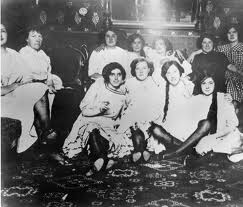
Prostitutes of the West worked in a hierarchical class structure, or a “whorearchy” (my term), in which the brothel was the highest rung. Also called parlor houses, they provided elaborate surroundings, luxuries, amenities, and the protection of a male bouncer if the clients became too rough. At the dawn of the twentieth century, one house in Colorado used electric lights, running water and a telephone. A staff of seven, including a bartender, a maid, and a musician, provided services other than sex. Of course, there were always five or six prostitutes. The Dumas Brothel in Butte, Montana was a three-story brick building that contained forty-three rooms and used pocket doors to create large rooms for parties.

Brothels differed in size and location, but the business structure for each remained basically the same. Respected businessmen owned most of the parlor houses but did not want their financial involvement to become commonly known. To accomplish this, they placed deeds under false names or in the names of their wives.

Madams were hired to oversee the day-to-day operations. These women usually emerged from the ranks of older prostitutes with experience in the profession and the knowledge and skills to recruit employees and customers. In fact, a few madams owned their own businesses.

Madams oversaw the business aspect of the brothels while the prostitutes did the work. A work shift began with the woman put on display. Therefore, when a man entered an establishment he found the women lounging in a parlor room. Here, he could choose someone in which to spend some time. When a customer chose a prostitute, he gave the money to the madam or someone else charged with the task. The amount paid depended on several factors, including house rate, the amount of time, and the beauty and skill of the woman.

Brothels built their business on pampering and catering to men who could afford the services. On average, a quick “date” cost five dollars, and an entire night cost between fifteen and thirty dollars. Owners depended on volume for profit by running twenty-four hours a day. With a shift of twenty-four hours, a women could conceivably have sex with twenty-five men and produce a tremendous amount of money. The house collected most of the fee, while the girls kept tips, sold photos and drinks, and stole from their customers. From this amount, the prostitutes paid their expenses, including clothes from local merchants at inflated prices, taxes to the local government, and bribes to the police.

Of Red Lights and Research

19 Dec

When I began my career as a graduate student in History, I knew that I wanted to focus on the American West. While popular culture has developed the myth of the lone rider traveling the region with absolute freedom, I realized that the truth was more complicated than that. People who went into the West were not looking for freedom. They were looking for economic opportunity. Therefore, I became interested in the economic aspects of the West rather than the typical subjects, such as gunfighters and outlaws. Of course, economics encompasses a great deal, and I was informed by my guiding professor that some limitation were in order. Then, the following transpired.

I would like to study the cattle industry.

There’s already a lot of research on that. What else are you interested in?

The mining industry was huge. How about that?

That’s been done to death, too.

Ok, what about the lumber industry?

That won’t work either.

(This is when I realized that I should go ahead and ask him what I should do.)

Ok, what should I do?

Did you ever think about researching prostitution? People are just not starting to look into it.

Sounds great to me. Thanks.

With that short conversation, I began life as an expert on prostitution in the American West. Through the years, I have read, researched, written and spoken about the economics of prostitution in the West and the everyday lives of the people involved in the industry. When people (especially men) find out about what I know about, they immediately start in. What are the brothels in Nevada like? Leave it to you to study whores. Ever study the whores on Dickerson Road (a notorious spot in Nashville)? I am left to explain that I have conducted scholarly research about dead prostitutes – not ones that are currently working. And, I did not choose the topic because I am a pervert. With this in mind, here is a synopsis of my life as a historian of prostitution in the West.

I went to graduate school in Tennessee, and my fellow students said only I would choose a topic halfway across the continent to research. People usually research something more conveniently located. However, I was not going to pick the Civil War or Andrew Jackson over the American West. I read all I could locally but knew that I would eventually have to travel. Luckily, I found two brothel museums fairly close together. The first was the Dumas Brothel in Butte, Montana. I spent several weeks in Butte and came to know the city quite well. Actually, there’s not much to know. I spent a lot of time at the Dumas, the archives and the Denny’s. I met some great people who helped me considerably and learned a great deal about the history of the city and of the Red Light District.

Wallace, Idaho sits just over the Idaho/Montana border and was home to the second museum, the Oasis Rooms. I only spent a few days in Wallace, but the people there were more than helpful. I took some great pictures and got some greater information.

With the information gathered from these locations and documents about the industry throughout the West, I was able to write a concise history about prostitution. In the midst of getting my graduate degree, I was hired at my current teaching position. As a new faculty member, students had no idea what to expect. Honestly, I had no idea what to expect either. But, I was determined not to let the research go to waste. I was going to talk about whoredom every chance I got. The first class was stunned when I gave the lecture on the 19th Century sex industry, and it was not long before word got around. I was the cool teacher that studied prostitutes instead of something uncool like regular History. From then until now, my classes constantly fill, and my office is always busy. They come by to see the photographs of prostitutes and the paintings of brothels on my walls.

As a small university, we are also expected to speak to community groups and perform other types of community service. This has created some interesting speeches for me. I am a member of the local Rotary Club and was asked to speak when I first joined. They insisted that I talk about my research. I tried to warn them that it wasn’t all fuzzy stories about Miss Kitty and the “whore with the heart of gold”, and they said it was fine. So, I gave them all the gory details. I think half of the audience was gone by the time I was finished, as several women walked out in disgust. Interestingly, no men left. I learned something that day. While people say they want to know history, they would rather not know the darker sides of the subject. I toned down the presentation after that experience.

Many people think that if I know about prostitution in the 19th Century American West, then I also know about prostitution at all other times as places. A retired colleague thought that and told the Daughters of the American Revolution that I would speak to them. When I said that they probably know more about the revolution than I do, he replied that I should talk about prostitution. I knew nothing about prostitution in the American Revolution, so I did some research. But, with the Rotary experience behind me, I was nervous about talking to a room full of elderly women. To make it go smoother, I used a historical code word – camp-followers – instead of a more descriptive term. As I spoke, I heard the following conversation between told ladies in the back.

What’s he talking about?

Camp-followers.

What?

Camp-followers.

What?

HE’S TALKING ABOUT WHORES!!!

Oh, now I understand.

So, now I am famous in my little town as the expert on whores. An older man in town, who has since passed away, came to me with a book that he had read about a madam in New Mexico. He had found a name in it that he recognized – mine. I was used as a footnote in the introduction, which was written by the professor who sent me on the journey through the Red Light Districts. I was proud to see my name in print and, for the first time, felt like a real historian. I bought a copy for my parents. They looked at it, and my mom said, “All those years of study, and you are in a book with a picture of a naked women on the front of it.”

Yep, I had made it.

Maybe I Should Give You Some History

16 Dec

As a historian, I feel that I have neglected my calling by not writing about some interesting aspect of the past. I haven’t written about it for several reasons.

1. I like to think that I am a well-rounded person with many interests and many things to write about. I hope those who have stumbled across the blog find those things entertaining and insightful.

2. History is my job, and I need this blog to be an escape from my job and other aspects of my everyday life. It is hard to escape my job because a lot of people have an interest in some aspect of the past. Often, they will ask me questions about a person or an event that they have already established an opinion about. The Civil War is really bad in these parts. They are Civil War buffs and think that I should be as well. You can’t realize how many times someone has started a conversation by asking, “You are a history buff aren’t you?” Actually, I’m not. I am a professional historian.

3. A lot of people find history boring. These are the ones who were probably forced to memorize dates by some football coach/teacher in high school. I figured that if I was going to get a lot of hits, then I should not focus on historical subjects.

With those in mind, I feel the need to give a little history lesson. As I thought about what to write, I realized that I did not want to throw out a big lecture. Then, I remember that several years ago my university came up with an advertising idea. We would buy radio time and provide 30 seconds of historical tidbits. The history faculty came up with some short stories to be read in these spots. It took quite a bit of time, but the ads were never recorded. I am thinking that there is no reason to let them go to waste. So. periodically I will put one of them on the blog. Not surprisingly, each one has a connection to my home state. Here is the first one.

Did you know that one of America’s most highly regarded sports writers was from Tennessee? Born in Murfreesboro in 1890, Grantland Rice began his journalistic career at the Nashville News before finally becoming a writer for the New York Tribune. When his column became nationally syndicated, Rice’s writing style – a combination of sports news, gossip and commentary – lead to popularity throughout the United States. Through Rice’s vivid descriptions and artistic use of the English language, fans could visualize teams that they had never seen. Famous for naming the “Four Horsemen” of Notre Dame, perhaps Grantland Rice’s most remembered line is derived from a poem. “For when the One Great Scorer comes to mark against your name, He writes – not that you won or lost – but how you played the game.”