Tag Archives: History

When Listening to Sports Talk Radio Leads to an Investigation of Woodstock

13 Oct

The other day, I was listening to a sports talk radio interview with John Fogerty. Apparently, he has a book coming out that needs to be promoted. He spoke on a lot of interesting subjects, but my ears perked up with he was asked about Woodstock. In short, he did not have a good opinion of the event.CCR

Fogerty said that Creedence Clearwater Revival went on three hours late for two reasons. The Grateful Dead would not stop playing, and the festival was run by people who had no concept of time.  By the time Fogerty and the gang hit the stage, most of the crowd was passed out. Although, there was one guy in the distance who was holding up his lighter.

I looked up the Woodstock schedule and found the truth behind Fogerty’s words. He did not take the stage until well after midnight. However, I also found out something else. Performers who epitomized the era were not at the concert that epitomized the era.

Bob Dylan lived in the area but was not on the bill. In fact, he got upset at the number of people who had shown up.

The Doors turned down an invitation because they thought it was a knockoff of the Monterey Festival.

The Byrds did not play because it was one of many festivals taking place.

Joni Mitchell missed Woodstock to be on The Dick Cavett Show.

Woodstock is in the history books and is considered a watershed moment for the 1960s counterculture. However, it was a business venture. The organizers wanted to make money, and the performers wanted to make money. Many of the people who sang the soundtrack of the 1960s missed Woodstock because they would not get enough pay.

Woodstock was a huge event but was it bigger than Monterey? Was it a better concert than the Atlanta International Pop Festival?

Part of me thinks the fascination with Woodstock comes from the documentary released in 1970. It won an Academy Award; paid off the debts of the organizers; and preserved the festival for posterity. On film, Woodstock looks like fun, but I wonder if it was that fun in real life.

Did you attend Woodstock? Was it as important as history says it was? More importantly, how was the show?
The One About Erwin Rommel Riding a Motorcycle Through Tennessee

23 Sep

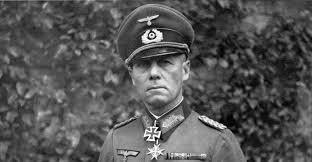
I was flipping through the channels and found a documentary about Erwin Rommel. I watched it for a few minutes but eventually lost interest. My mental quota for documentaries about Nazi Germany has been filled for a while. However, the documentary brought to mind a story from long ago.

When I was a kid, I heard that, before World War II, Rommel traveled to Tennessee a studied the military tactics of Nathan Bedford Forrest, a southern cavalry general who operated in these parts.

Yes, I was the kind of kid who found that kind of story interesting. I was the kind of kid who knew who those people were.

Anyway, the story continued with proof. Apparently, there was an old hotel register in Waverly, Tennessee that had Rommel’s signature.Rommel

Through the years, I have thought about this story and never questioned it. I have told people about it. Heck, I have even mentioned it in class. However, I never thought about digging into it and finding out what happened….until last night.

I typed a bunch of stuff into Google about Erwin Rommel, Tennessee and Nathan Bedford Forrest. I did not find much, and I began to worry. If he was around here, then something would be written about it. The only thing I could find was an article called Second Guessing the Past – The Desert Fox and Mississippi at hottytoddy.com. For those who do not know, “Hotty Toddy” is a cheer at the University of Mississippi, which will not make my colleague from Mississippi State University all that happy.

I encourage you to read the linked article, but I need to offer a synopsis. The writer traveled to West Tennessee to track down a story that he had always heard about Rommel visiting the state. People told him stories of seeing Rommel riding a motorcycle and talking to him on their front porches. The memories of these sightings were as vivid as if they had just happened.

He found out that Rommel was in Clinton, Tennessee and signed a hotel register. The hotel, which no longer exists, even placed a plaque on the room where he stayed. It was called the “Rommel Room.”

After visiting Clinton and talking to people who met Rommel, the writer visited Manfred Rommel and asked him about his father’s trip to the United States. It turns out that Rommel never made the journey. The son was told the stories of people who met his father, but he insisted that his father never traveled to Tennessee.

Reading, the article will provide you with a better sense of the story, but chances are that Rommel was never in this state. The story that I was told and repeated never happened. Heck, the story I heard was wrong about the town. However, it makes me wonder about memory and legends and all sorts of things that historians have to deal with.

People were convinced that they met Erwin Rommel and were convinced of a signed register proved it. Did they make it up? Did they tell the story long enough that they started to believe it? Did they actually meet a German officer who was riding around on a motorcycle? If so, then who was he? Did he introduce himself as Rommel? Since Rommel did not become famous until World War 2, why would meeting him before the war be considered a big deal? Did they meet a traveling German and assume it was Rommel after they started hearing his name?

It is a simple story, but it leads to question after question after question. I only know that it is a story I have heard for years, and it is one that a lot of people believe. It is even mentioned in The Tennessee Encyclopedia of History and Culture, which is a good site because I have an article on there. It would be nice to know its origins and how it came to be thought of as fact.

That would make a better documentary than the one that I turned off.


Watching Ken Burns Twenty-Five Years Later

9 Sep

It is a slow night at our household. We just got home from a volleyball match, and the other members of the family have disappeared into some corner of the house. The dog is on the couch and The Civil War by Ken Burns is on television. Apparently, this is the 25th anniversary of the granddaddy of all historical documentaries.Ken Burns

I had forgotten about all of the famous people who leant their voices to the documentary. Sam Waterson. Jason Robards. Morgan Freeman. Garrison Keillor. Arthur Miller. George Plimpton. The list goes on and on.

David McCullough narrated but Shelby Foote became the star. His slow drawl and colorful descriptions captivated viewers.

After all these years, the documentary still makes a historical and emotional impact.

I hear activity around the house. The rest of the family must have ended their project and headed in various directions. David McCullough and Shelby Foote are still talking, but they are now joined by cabinets closing and the dog eating.

A long time ago, I watched The Civil War alone in a quiet house. Watching it this way is a lot better.

Dates and Jams

3 Sep

My friend over at Serendipity created a great post, and I, like any good blogger, am going to copy it. She found a site called Birthday Jams that will tell you what was at the top of the charts on the day that you were born.

On my day of birth, The Supremes had “You Keep Me Hangin’ On” hanging out in the Number One spot. However, it gets better. In the United Kingdom, Hugo Montenegro and His Orchestra hit big with the theme from The Good, the Bad and the Ugly. I knew I liked that movie for some reason.

As I fiddled with the site, I started to wonder about what people were jamming to when big events happened. For example, Neil Armstrong stepped onto the moon on July 20, 1969. Do you know what song was tops in the land on that day? “In the Year 2525” by Zager and Evans

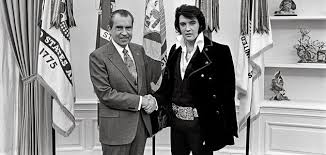
On August 9, 1974, Richard Nixon became the first president to resign from office. As he flew off in his helicopter, somebody was listening to “Feel Like Makin’ Love” by Roberta Flack. Nixon also posed in one of the greatest photographs of all time with Elvis Presley.Elvis Nixon

A few years later, the nation was saddened by the death of Elvis, who had a ton of Number One hits. On August 16, 1977, the day he passed away, “Best of My Love” by The Emotions was playing on radios everywhere.

Elvis’ career began when he walked into Sun Studios. He struggled for a while but finally got into a groove on July 5, 1954 when he recorded “That’s All Right.” The nation did not know what was about to hit them. All they knew was that Kitty Kallen had a huge hit with “Little Things Mean a Lot.”

Obviously, December 7, 1941 is a huge date in American history. The Japanese attacked the island of Oahu and our base at Pearl Harbor. The nation was about to enter a war that had been raging for a couple of years. It was also the day that people were listening to “Chattanooga Choo Choo” by Glenn Miller.

On December 15, 1944, Miller’s plane disappeared somewhere over the English Channel. On that day, Ella Fitzgerald and the Ink Spots hit with “I’m Making Believe.”

On September 10 1993, a television show debuted that asked us to believe. As The X-Files started its rise to popularity, “Dreamlover” by Mariah Carey hit the peak of the charts.

Of course, that was a few years after Larry Hagman first dreamed of Jeannie. That show went on the air on September 18, 1965, which was the same time that The Beatles did not need any “Help!”

Of course, The Beatles would break up and go on to solo careers. Tragically, John Lennon’s life was cut short on December 8, 1980. On that day, “Lady” by Kenny Rogers was sitting at Number One.

Rogers used his popularity to transition into movies. None of them were very good, but Six Pack was one of the worst. It hit the screens on July 16, 1982. Listening to “Don’t You Want Me” by The Human League had to be better than watching that film.

I reckon this exercise needs to eventually come to an end, and that will happen with one more date.

I am not going to release the date of my wife’s birth, but that event turned out to be important in my life. In other words, it needs to be recognized. One way to do that is to tell you that Neil Diamond’s “Cracklin’ Rosie” was the big hit of the day. By the way, her name is not Rosie.

Know What You Are Talking About Before Bringing It Up On The Radio

1 Sep

Several months ago, I was listening to the afternoon show on our local sports talk station. They call themselves 3HL because they used to be on around lunchtime. For those outside of Nashville, 3HL is supposed to stand for 3 Hour Lunch. Anyway, they are no longer on at lunch, and the name does not stand for anything.

On this particular afternoon, the discussion, as it often does, turned away from sports and toward something that could be considered historical.

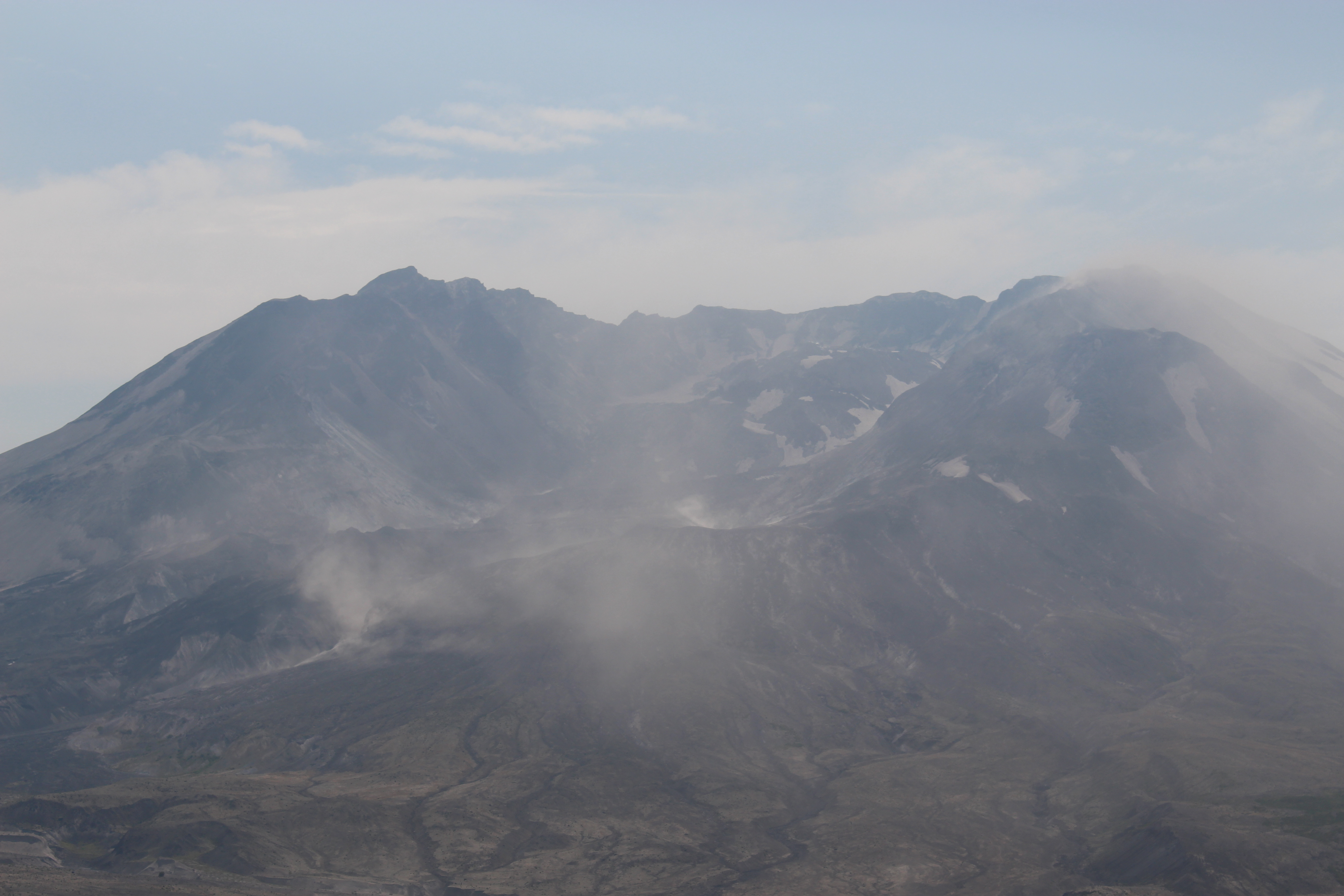
For some strange reason, they were talking about Ernest Borgnine. I like Ernest Borgnine, but I wonder how many listeners have ever heard of him. Anyway, they started talking about some of his roles and remembered the made-for-television movie that he made about the explosion of Mount St. Helens. They knew that the man he portrayed stayed on the mountain and was never found. However, they could not remember his name.

I decided to help them out. We had just returned from a trip to Oregon and Washington and had visited the mountain.IMG_2917

I tweeted the show and told them that the man’s name was Harry Truman. I knew this because of our trip, but I also remembered it from when the disaster happened. Truman was on television all of the time, and, for obvious reasons, his name stuck out.

They read my tweet on the air and immediately brushed it aside with comments like:

“Harry Truman was president.”

“He must be thinking about another Borgnine movie, Harry and Tonto.”

I was livid. Obviously, they did not know that I just visited the mountain, but they could have read my Twitter profile. It plainly states that I am a historian. In other words, I know a little about what I am talking about.

Finally, somebody called in and said that I was right. The man on the mountain was Harry Truman. The radio guys acted shocked at this information and could not believe that I was right.

I have pretty much stopped listening to 3HL, but I have some advice for radio hosts throughout the land.

If you are going to talk about history or pop culture, then you should know what you are talking about.

If you do not know what you are talking about, then you should listen to people who do.

By the way, there is this thing called Google.


Cumberland’s Grover Cleveland

28 Aug

This week, Cumberland University, my place of employment, announced the appointment of a new president. It was a great day of celebration and hope for a bright future. In my opinion, the search committee and the Board of Trust made an inspired choice to lead our institution.

Last night, I was reading news reports about the announcement and decided to see if our Wikipedia page had been updated. While skimming over the Wiki information, I noticed a discrepancy. When the new president was introduced, we were told that he is the 26th president of Cumberland University. However, Wikipedia listed him as the 27th.

I jumped on Twitter with the question of which is correct and was told that Nathan Green, Jr. served two nonconsecutive terms. In the view of the university, he counts as one president. That is when I mentioned that Grover Cleveland served as president of the United States for two nonconsecutive terms and counts as two presidents.

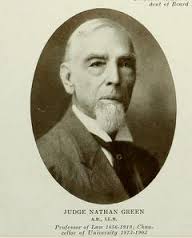
Apparently, we count presidents differently that United States counts presidents. That is when my colleague chimed in with “Nathan Green, Jr. = Cumberland’s Grover Cleveland.”Nathan Green

We still have not figured out why Cumberland University counts presidents differently than the United States counts presidents, but, since Nathan Green, Jr. caused this mess, I feel the need to tell you more about him.

Green was born into a prominent family on February 19, 1827 and followed his father, who served on the Tennessee Supreme Court, into law. He was one of the founders of the Cumberland School of Law  and taught for over sixty years. This included stints as president from 1873 to 1902 and from 1906 to 1909.

Some people credit Green with ushering the university through the Civil War and Reconstruction, and others blame his adherence to outdated legal training as weakening the law school, which would eventually be sold to Samford University.

Green lived a long life and died on February 17, 1919. His life was interesting and full of achievement but wait until I write about his brother Tom Green. It is a wild and wooly story.

The Phrenology Head

20 Aug

Over the weekend, my wife was shopping, and I was wandering around the store. Suddenly, I saw it. Without hesitation, I picked it up and took it to the shopping cart. It was something that I had to have. It was a Phrenology Head.image-50

My wife immediately asked what I was going to do with it and breathed a sigh of relief when I said that I was taking it to work. I thought it would look interesting in my office and be a conversation piece. I was not wrong.

When my stepdaughter saw it, she asked what it was. I said it was a head. When I was unlocking my office door, my colleague asked what I had. I said it was a Phrenology Head. That means that most of the people who have seen it have made a comment about it. That is the definition of a conversation piece. Hopefully, my students will talk about the Phrenology Head when I take it to class.

That is the other reason I bought it. In the first semester of United States history, I talk about Phrenology and other such things from our past. In essence, it was the study of the human head. Practitioners would measure skulls and search for bumps and indentions. Different parts of the skull represented different parts of the brain. On top of that, each part of the brain controlled a different aspect of that person. A bumpy, indented skull meant one thing. A smooth skull meant another.

It was all very scientific.

My students laugh when we talk about Phrenology, and they will probably laugh when they see the Phrenology Head. However, it was serious business. The research was used to justify European superiority over other people. If you have ever seen the dining room scene in Django Unchained, then you know what I mean.

There is a Phrenology Head sitting on my desk, and I am waiting for the first student to walk into my office. Hopefully, they will ask about it. If not, then they are probably being polite to the crazy teacher who has this strange head. Of course, I am talking about the Phrenology Head. Although, I wonder what information a Phrenological study would get from my cranium.

The City Historian

11 Aug

A few months ago, our city council appointed me to the position of city historian. It was an honor to be chosen as the keeper of our historical gates. At that city council meeting, I told a story that I will never forget.

I was in a meeting about attracting tourists to our area, and someone said that we could not attract people because our city had no history. At that point, I rattled off a list of people and events from our past. When I finished, this person said that we did not have real history like a presidential home.

Forty-three people have served as president. That means that there are a ton of cities that do not have presidential homes. They have history, and they attract tourists.

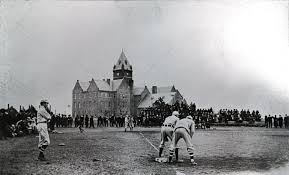
At my appointment meeting, I stated my goal that no one would make that statement again.Baseball

As city historian, I have inventoried the artifacts and documents at our local museum, and I have joined our historic commission. However, I have not spread the word about our city’s interesting history.

To fix that in a small way, I started a Twitter account @LebanonHistory to share short stories about the past. If you have Twitter and are interested in history, then I would appreciate the follow.


The Orange Side of Savannah, Georgia

26 Jul

Last week, we spent some time in Hilton Head, South Carolina, but, in my mind, the best day consisted of a drive to Savannah, Georgia, the settlement established by James Oglethorpe when he first colonized the area. It is an old city with lots of history, and we rode a trolley through it all.

We saw the squares for which the city is famous filled with Live Oaks with Spanish Moss hanging from the branches. Each square is surrounded by a church and stately homes. One home was the headquarters for William Tecumseh Sherman when he captured the city on the completion of his march to the sea. Another home belonged to the family of Johnny Mercer and was the site of a murder that inspired Midnight in the Garden of Good and Evil – both the book and the movie.

Since movies were brought up, we saw where Forrest Gump sat on a bench and told his life story but missed an entire square because Adam Sandler was in the process of filming a scene. I was hoping to see where Burt Reynolds filmed parts of Gator, but the tourism folks do not promote that one as much as others.

We saw a lot of interesting places. The location of John Wesley’s first sermon in the New World. The docks where cotton was loaded onto ships bound for England. Of course, no one mentioned the slaves who worked the cotton. To make up for that lack of information, we saw a building used by the Underground Railroad.

Savannah is a beautiful city of architectural wonders and almost three hundred years of history. It was also filled with people trying out for American Idol. Unfortunately, I did not get any pictures of that stuff. Our trolley ride made photography difficult. No pictures of Live Oaks. No pictures of monuments or statues.

However, I was able to take a picture of this place.image-44

When it was time for lunch, I asked the man at the visitor center counter a simple question.

“If you were going to lunch where would you go?”

He started down the typical list that included Paula Deen’s and other places where tourists are directed. I knew that he would not pick any of those places but could not deviate from the script. We wanted to eat with the locals, and this guy offered no help.

On the trolley ride, we passed a place that looked like what we wanted. Clary’s Cafe had a few outdoor tables and was off the beaten path. It did not take long to choose that over standing in line at one of the other places. We got out the trusty GPS and made our way through the squares and around Adam Sandler.

We pulled into the parking lot and made our way to the door. However, my wife was nowhere to be seen. She was standing behind the car talking to someone. It turned out to be the owner of the restaurant who saw the orange T on the front of my vehicle. For those who are not from around here, that is my signal to everyone that I am a fan of the University of Tennessee. As it turns out, the owner was also a fan of the Big Orange.

We talked for a while about the upcoming football season and the orange shrine her husband built at their home. They are from Tennessee and make it to as many games as they can. She has high hopes for the upcoming season and thinks Butch Jones has the program on the right track.

Eventually, we made our way inside and found what we were looking for. Sweet tea was in the pitcher, and lima beans were part the day’s special. It was a true southern restaurant that did not involve a television personality. However, that was not the best part.

As we finished our meal, the owner told the waitress to give us the Big Orange discount. After all, we were part of her college football family.

Power’s War – A Review

10 Jul

There is a mythology to the American West. It involves people living a life of complete freedom without the restraints of established society and government. If a problem needs to be handled, then it is handled by individuals. When the dust settles, the good guys have beaten the bad guys, and the life of complete freedom continues.

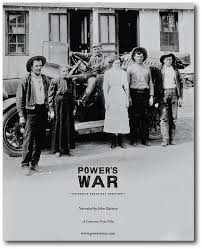
Filmmaker Cameron Trejo exposes this myth with Power’s War, a documentary that chronicles a tragic event in the wilds of Arizona.Power

Jeff Power settled his family near Klondyke, Arizona and, as thousands of people had done for decades, attempted to find fortune in a mineshaft. It was a harsh life of backbreaking work and isolation. For daughter Ola May, it was too much isolation, and she died mysteriously. For Jeff, it was too little isolation, and the world encroached on his plans.

The myth of the American West leads us to believe that people who lived in the region did so without the shackles of life in the east. This falsehood discounts the mountain men who worked for fur companies based in eastern cities; the cowboys who rode for cattle companies owned by London stockholders; and the miners who worked for huge mining companies.

For historians, it is difficult to peel back the layers of the myth and teach people about the realities of the West. Unfortunately, Jeff Power learned of those realities in the most tragic of ways. His family may have lived in a remote wilderness, but they were connected to a larger world.

In 1917, the United States entered World War I, and a patriotic fervor gripped the nation. Men registered for the draft, but Jeff and his sons, John and Tom, thought the war was secondary to their mining claim. Why should they fight a war in a foreign land when the land they were on held the potential for prosperity?

On February 10, 1918, lawmen looking for the draft dodgers surrounded the Power cabin. The resulting shootout, the largest in Arizona history, has been largely forgotten. The complete story will not be told in this review. That would take away from the need to watch this excellent documentary.

Trejo uses interviews, sweeping panoramas and the touch of a graphic novelist to tell the stories of the Power family and others who were affected by the events. Their tales are tragic, but they provide the perfect example of the western experience. It was not romantic. It was not good guys versus bad guys. It was people trying to survive in a harsh world while the rest of the world pushed its way in.

Cameron Trejo tells the story of a family living in a canyon near Klondyke, Arizona, but he is also telling the story of the American West.