Tag Archives: Westerns
Movie Wisdom – Lee Marvin Edition

11 Feb

The other day, my dad and I watched a Western that I had never seen before. Seven Men From Now starred Randolph Scott as the hero and Lee Marvin as one of the various villains. After watching the film, I read that John Wayne produced the film and planned on starring in it. However, John Ford wanted him to be in The Searchers.

As it turns out, this was a good move for everyone. John Wayne played one of films most iconic characters in a movie that many feel is the greatest Western ever made. Randolph Scott credited Seven Men From Now as the movie that revitalized his career.

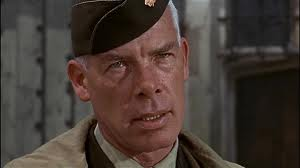
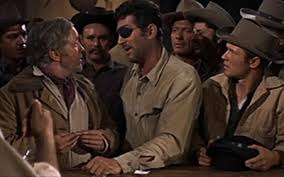
That is a lot of information to throw out without writing about what is really on my mind. Lee Marvin was great in the movie and watching it brought to mind the other great films he was in. That means that we are now going to explore the movies of Lee Marvin to see what words of wisdom we can glean from them.Lee Marvin 2

From The Caine Mutiny

Ninety-nine percent of everything we do is strict routine. Only one percent requires creative intelligence.

From Bad Day at Black Rock

I believe a man is as big as what he’s seeking.

Somebody’s always looking for something in this part of the West. To the historian it’s the Old West, to the book writer it’s the Wild West, to the businessman it’s the Undeveloped West.

It’s gonna take an awful lot of whiskey to wash out your guts.

From Seven Men From Now

A man oughta be able to take care of his woman.

From Raintree County

Greatness? Ha! If that great philosopher, Socrates, were living today, he’d be reduced to sitting on a cracker barrel, chewing tobacco. That’s what America does for greatness.

War is the most monstrous of man’s illusions. Any idea worth anything is worth not fighting for.

The home-grown tomatoes are always best.

From The Comancheros

I got one rule: never go to bed without makin’ a profit.

From The Man Who Shot Liberty Valance

When the legend becomes fact, print the legend.

Credit is cheap.

Courage can be purchased at yon’ tavern!

As for you, Old Man: go West and grow young with the country!

From The Dirty Dozen

I never went in for embroidery, just results.

From The Big Red One

Surviving is the only glory in war.

From Death Hunt

Well, I just figure any man who risks his neck to save a dog’s life isn’t going to kill someone for gold teeth.

All of that and more can be learned by watching more Lee Marvin movies.

It Was A Very Good Year

3 Feb

Due to events out of my control – namely, a trip to Cancun and the start of school – I never got around to analyzing my year-end fireworks show and review. As Frank Sinatra sang, it was a very good year.Frank Sinatra September

It was also a very interesting year because only one of the top five posts was written in 2013.

Into the Sunset (April 2013) is the one that got Freshly Pressed. If you ever wondered what happened to the cowboy after he rode into the sunset, then you may want to check it out.

Movie Wisdom – Burt Reynolds Edition (May 2012) is the first in a series of posts about bits of wisdom to be found in movie dialogue. You would be surprised at how many people want to know what Burt Reynolds had to say. That is especially true for one line in Smokey and the Bandit.

Listeria – Gunslingers Edition (November 2012) is exactly what the title says – a list of the great gunfighters of the West. It probably gets attention because of all the names tagged in it. However, the best part can be found in the comments. Somebody wanted me to know that I had the death date of Jesse James wrong. He faked his death and lived to be an old man.

Listeria – Western Actors Edition (October 2012) is also what the title says – a list of the great actors known for the Western genre. It also gets attention because of the names that are tagged. Check it out. If you can think of something who should be on the list, then let me know.

The Problem With Gas Pumps (November 2011) is one of the first posts I ever wrote. For a long time, it dominated the stats of the blog. For a while, it was like everyone was searching for gas, gas pumps, gasoline pumps or pictures of gas pumps. Its rule over the SBI world has faded, but it will definitely be the first inductee into my personal Blogging Hall of Fame.

The annual report also lists the top commenters of 2013. Feedback is important, and I appreciate everyone who has taken the time to read and comment. These are the ones who commented the most.

Dying Note has been commenting on this blog almost as long as there has been a blog.

Marilyn over at Serendipity is someone I always like to hear from.

Manu Kurup is a frequent commenter and great blogger.

Front Range Scribbles posts great comments and has introduced new music to an old music lover like me.

My Favorite Westerns is a great place to go to learn about that movie genre, but a lot of great comments about other subjects also come from there.
Oh, you might like to know the top search terms for 2013. I wonder who many blogs have Johnny Ringo and Porno as the top two search terms. If you find one, then let me know. I would like to read it.

The Westerns of Dean Martin
11 Jun

I have been reading about the Rat Pack and the exploits of its members – Frank Sinatra, Dean Martin, Sammy Davis, Jr., Peter Lawford and Joey Bishop. Together, they were legendary. However, I have been thinking about their individual careers.

Obviously, Frank Sinatra is one of the most famous performers of all time.

Sammy Davis, Jr. also had a great career.

Peter Lawford is probably best known as a Kennedy in-law.

I’m not sure what else Joey Bishop did.

Dean Martin, though, is my favorite. He sang great songs and made great movies. Some of the best movies were Westerns. For a cool crooner, Martin was pretty handy on a horse and with a gun.

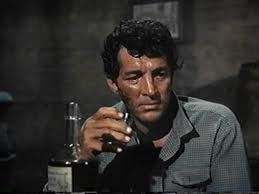
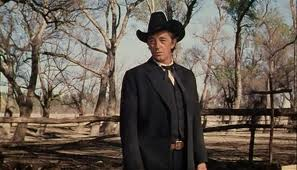
In my mind, his best Western was Rio Bravo, starring John Wayne, Ricky Nelson and Walter Brennan. Here’s a trivia question. How many people in Rio Bravo had records that reached Number 1? The movie is about a sheriff who has arrested the brother of a wealthy rancher. He and his deputies have to fight to keep him in jail and to stay alive. Martin plays Dude, a deputy who doubles as the town drunk.Dude

Another great thing, Rio Bravo was filmed at Old Tucson Studios, one of my favorite places to visit.

5 Card Stud is another good one. Martin plays Van Morgan, a gambler who has to solve a series of murders before he becomes the next victim.5 Card Stud

Everyone who is killed was playing in the same card game. It also stars Robert Mitchum and Inger Stevens but suffers from what I call the “law of diminishing suspects”. There are so few suspects that solving the mystery is too easy.

Bandolero! pairs Martin with James Stewart as brothers who have taken different paths but find themselves in trouble together.Bandolero

Along the way, they take Raquel Welch hostage.

My least favorite Dean Martin Western is The Sons of Katie Elder. It stars John Wayne and has the makings of a great story, but the “sons” are mismatched. The youngest “son” is way too young to play the part. I hate to say that a Western starring John Wayne and Dean Martin is bad, so I will say that it’s not very good.

Martin is the gambling brother, Tom Elder, and he follows older brother John in trying to figure out who killed their father. One of the best scenes has Martin playing a “fake eye” trick in a bar.The Sons of Katie Elder

Dean Martin made other Westerns, but these are the ones I have seen. Honestly, I don’t think I could make it through the comedy ones with Frank Sinatra.

Into the Sunset

1 Apr

It’s a cliché of the western movie genre. The hero has lived through some adventure, and, when it’s over, he gets on his horse and rides into the sunset. I have watched that scene dozens of times, and it fascinates me every time.

What happens when they disappear over the horizon? What happens after the “The End” placard covers the screen? Does the hero take time off before finding another adventure? Does he die of wounds suffered during the movie? Does he live happily ever after in some frontier town?

All of those questions go through my mind because I have to know the rest of the story. It doesn’t matter how bad the movie is. I still want to know what happens after the credits roll. However, something else goes through my mind, as well. The “into the sunset” scene isn’t always the same.

One of the greatest “into the sunset” scenes doesn’t even have a horse. In The Searchers, Ethan Edwards spends years attempting to rescue his niece from her Comanche captors. When he returns with her, everyone goes into the house except for him. He turns and walks into the desert as the door closes behind him.The Searchers

Where did Edwards go? Did he leave because most of his family was dead? Did he wander because there was no purpose in his life? All of the wars were over. Or, did he think back over the past years before turning around and coming back?

John Wayne walked away in The Searchers, but Clint Eastwood could be the king of “into the sunset” rides. In The Outlaw Josey Wales, he is bleeding as he rides away. Does he live? If so, then does he go back to the friends that he has gained throughout the movie? Or, does he disappear from history?

Sometimes, he completely disappears because we really don’t know what he is. In Pale Rider, Eastwood evaporates from the scene. Is he some kind of spirit or is he just a mysterious gunman?

Those were great, but my favorite Eastwood ending comes from The Good, the Bad and the Ugly. Blondie leaves Tuco with a noose around his neck and gold at his feet. After an impossible rifle shot to save Tuco, Blondie rides away to one of the greatest movie scores of all time.

A more recent western has an “into the sunset” scene at the end. The difference is the adventure that precedes it. In Cowboys and Aliens, James Bond defeats aliens with the help of Indiana Jones. Oh, Boyd Crowder helps out, too. This time the hero is truly a loner. His wife is dead. His alien love interest is dead. He is considered dead. Heck, the dog doesn’t even go with him. In this one, the hero probably went somewhere and cried.

The cool thing about “into the sunset” scenes is that they are no longer reserved for westerns only. Remember what happened at the end of The Dark Knight? He agrees to be the fall guy and live life as a villain. Then, he hops on his jacked out motorcycle and rides into a tunnel. There is no sunset, but there is a cool speech and some kind of light up ahead. I hope it’s not a train.The Dark Knight
Everybody knows what happened to him after that because we have sequels now. There should not have been a sequel to this one. Wondering what happened to Batman was a lot better than knowing that he faked his death and ended up with Catwoman.

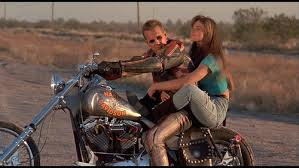
Ok, so John Wayne, Clint Eastwood, James Bond and Batman all have had great scenes to end movies. However my favorite “into the sunset” scene comes from a movie that isn’t very good. At the end of Harley Davidson and the Marlboro Man, Don Johnson, as Marlboro, goes back to his roots and enters a rodeo. At the same time, Mickey Rourke, as Harley, rides his motorcycle into the sunset with an 80s vixen on the back and Black Eyed Susan playing in the background.Harley Ending

Why is that my favorite? Because it’s the only one that seems like a happy ending. He’s not alone. He’s not wounded. And, there is no doubt that something good is going to happen further down the road.

Listeria – Western Actors Edition

24 Oct

I know that this edition of Listeria is coming along soon after the last edition of Listeria, but I went overboard on my last trip to the magazine stand. Besides, this one covers one of my favorite subjects – Western movies. I grew up watching them with my dad, and that experience played a role in my interest in the history of the West.

American Cowboy published a special issue called “Legends of Western Cinema” and listed the 20 greatest Western actors. However, there is one problem that needs to be addressed before I begin. When people think about Westerns, or the history of the West, they think about cowboys first. Some of the greatest Westerns don’t involve cowboys at all. They involve mountain men, Native Americans, cavalry and all sorts of characters. In the real West, not everyone were cowboys. A good way to see this? If there are no cows around, then there are probably no cowboys around.
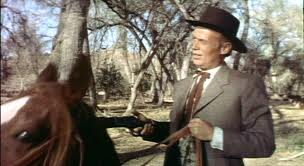
The rant is over, so here we go with the list. These are the 20 greatest Western actors according to American Cowboy in the order that they have listed. I will list my favorite movie of each and add the actors that I believe should be included.

John Wayne – The Searchers

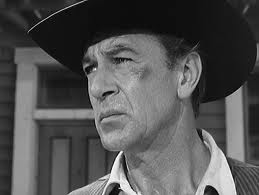
Gary Cooper – High Noon

James Stewart – The Far Country

Henry Fonda – Once Upon a Time in the West

Clint Eastwood – The Outlaw Josey Wales

Steve McQueen – The Magnificent Seven

Kirk Douglas – There Was a Crooked Man

Robert Duvall – Open Range

Ben Johnson – She Wore a Yellow Ribbon

Lee Marvin – The Man Who Shot Liberty Valance

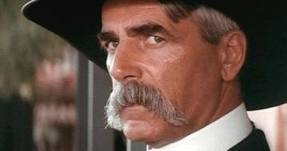
Sam Elliott – Tombstone

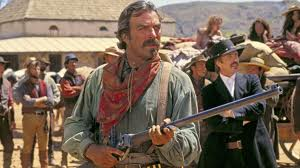
Tom Selleck – Quigley Down Under

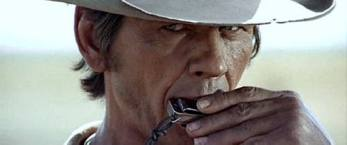
Charles Bronson – Once Upon a Time in the West

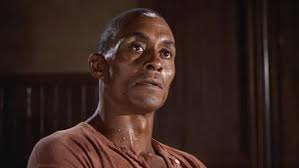
Woody Strode – Sergeant Rutledge

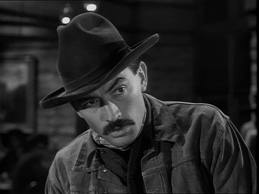
Gregory Peck – The Gunfighter

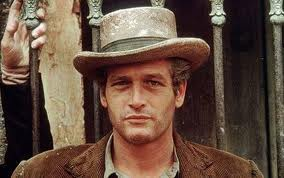
Paul Newman – Butch Cassidy and the Sundance Kid

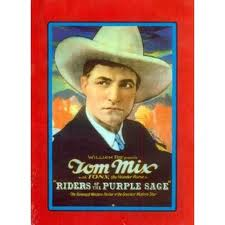
Tom Mix – Riders of the Purple Sage

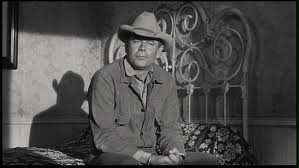
Glenn Ford – 3:10 to Yuma

Tommy Lee Jones – No Country For Old Men

James Garner – Duel at Diablo

That’s the Top 20. I could name a bunch that belong on the list, but I will limit myself to five.

Randolph Scott – Ride the High Country

Kevin Costner – Silverado

Robert Mitchum – Five Card Stud

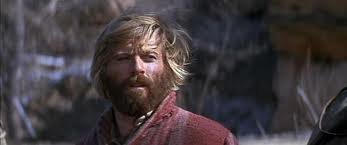
Robert Redford – Jeremiah Johnson

Richard Widmark – Broken Lance

There is the list. Who else should be included? Who should be omitted? What are your favorite movies? Let me know.

Imagining the West

5 Jun

When the United States completed the Louisiana Purchase, a question arose among politicians and citizens around the country. What exactly did Thomas Jefferson buy? Some of it was known, but, frankly, a lot of it was a mystery. Like today, mysteries led to wild rumors and speculation. Some thought that the land was filled with mammoth. Others theorized that giants walked the land. Even the reports of Lewis and Clark did not quell the wild stories about the land that they traveled through.

This began a long fascination with the western landscape among Americans. While some ventured into the region, the vast majority was content with staying in their comfort zone and leaving the visions of the West to their imaginations. While they read dime novels exaggerating the exploits of the people in the West, they were also fed exaggerations of the images of the West.

It is easy to see how someone in the 1800s could incorrectly imagine the West as they read a book that was designed to be as adventurous as possible. The visuals were left up to them, and they only knew what the writer wanted them to know. However, the 1900s brought the invention of films. Now, the story could unfold in front of their eyes. No more imagining. They could see the real West.

Unfortunately, that’s not exactly the way it happened. The first “westerns” were filmed at Thomas Edison’s studio in New Jersey. I’m not even sure it was in western New Jersey. When the motion picture industry moved to Los Angeles, things did not get much better because movies were filmed close by. In other words, a story that was based in Texas was filmed in California. As people watched, they began to assume that Texas, and the West in general, looked like the place they were seeing on the screen.

Last night, all of this came into focus for me as I watched television with some friends. Longmire, a new show about a modern-day sheriff in Wyoming, premiered on A&E, and I had been looking forward to it. To my disappointment, it was a weak attempt to copy th success of Justified, but I digress. My friends, who have never been to Wyoming, were talking about the scenery and how beautiful it was. I have been trying to convince them to take a trip to the West instead of their usual beach excursion, and they began to get excited about going to Wyoming and seeing this beautiful place.

Wyoming is beautiful. It is one of my favorite states. However, if my friends want to see the landscapes of Longmire, then they will need to go to northern New Mexico, the filming location. I thought it looked familiar because I was just there. Anyway, I had to explain that westerns are not always filmed where the story takes place and that it has confused audiences for decades. I wondered how many people will watch the show and think that Wyoming looks like New Mexico.
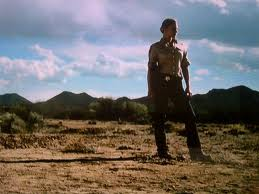
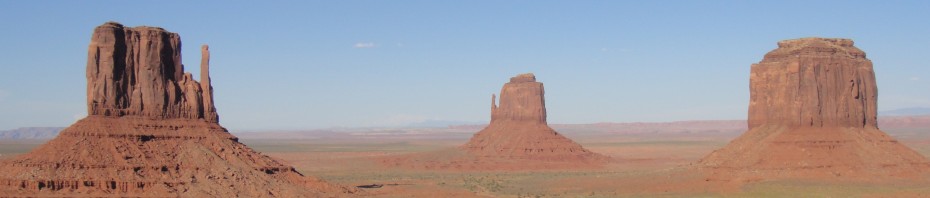
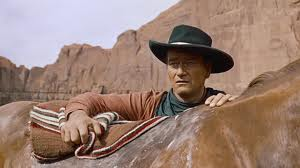
Today, another example of filming that confused the audience popped up on my television. The Searchers, starring John Wayne as Ethan Edwards, is one of my favorite movies. It follows a loner who goes on a decade-long trek to find his niece who was abducted by Comanche. I could write about this movie all night but need to focus on the scenery in which the action takes place. The director, John Ford, used his favorite filming location, Monument Valley, because of its grand vistas. In fact, I used a photograph of Monument Valley for the banner above.

The problem is that the story takes place in Texas while Monument Valley sits in Utah. Through the years, I wonder how many people think Texas, an iconic locale for western stories, looks like that. I can promise that it doesn’t.

People have always imagined the West differently. In the 1800s, misconception was understandable because technology and transportation did not offer easy opportunities to see it. During most of the 1900s, a trip into the West was also difficult for many. However, today, with interstates and internet, there is not excuse for imagining the West incorrectly. I urge everyone, if provided with the opportunity, to travel through it and see for yourselves.

Wyoming does not look like New Mexico, and Texas does not look like Utah. However, each of those places and all of the rest have a beauty all their own. Don’t be fooled by the movies and television because the West is more magnificent than they can show and you can imagine. Plus, it will all be in the right places.

Your Assignment…Should You Choose to Accept

27 Jan

This semester I have the good fortune of teaching my favorite class, a history of the American West. This is my major area of study, and I get a kick out of talking about all of the things I have researched and written about. However, it needs to be fun for the students as well. I believe that many historians do a wonderful job of making an interesting topic as boring as possible, and I attempt the opposite. History is fun for me, and I want the students to have the same experience.

Several years ago, I developed something that the students call the “Movie Assignment”. They watch a movie based within the time period we are discussing and compare it to actual events. The scenery and action of the films provide them with a visual clue of what may have been like, and the story often gives them an idea of life itself. Obviously, not all movies are appropriate for this type of activity. Pearl Harbor may have been the dumbest plot ever written. Therefore, World War II class did not get the option to watch it. They got movies with deeper meanings and more of a foundation in reality.

In the American West, students have the pleasure of watching films from my favorite genre. Except, there is a different aspect to the assignment. Western settings have long been used to offer more contemporary lessons. Think of it as the Mt. Olympus of the United States. It is the place with myths are made, and flawed heroes face decisions with no correct answers. To get the students on the right path, I recently assigned each of them a movie to watch. We haven’t discussed what they should look for because I want them to watch the movies for enjoyment first. This post lists the movies and why I chose them. If you get the chance to watch them, then perhaps these are things you can look for.

1. Rango– I know, it’s a cartoon. However, it pays homage to westerns throughout the decades. Watching closely, you can pick up small details that bring to mind the great western movies and western actors. Besides, how can a movie be bad when “The Man With No Name” shows up as the Spirit of the West. I only that the original “Man With No Name” could have been used to voice the character.

2. The Man Who Shot Liberty Valance – “This is the West, sir. When legend becomes fact, print the legend.” One of the great lines in western history and an statement that describes how difficult it is for historians to dig through the legend to get to the fact. This film is filled with symbolism, as each character represents an aspect of the “taming of the frontier” experience.

3. Fort Apache – The second John Ford/John Wayne movie on the list (TMWSLV was the first), this is one of the first movies to show Native Americans in a positive light. It takes real battles of the Indian Wars and combines them into a fictional one. In the process, it shows the misguided policies of the United States toward native peoples. This could be relavent for a lot of times in history – Indian Wars, Vietnam War, Gulf War.

4. The Searchers – The third John Ford/ John Wayne installment (I promise that they don’t make up the entire list) is an epic about a man searching for his niece, who was kidnapped by Indians. It shows his maniacal racism toward these people and how it increases throughout the film. Most of the underlying currents were missed by the audiences of the time, but they come to light as the years pass.

5. The Magnificent Seven – A remake of the Japanese film, The Seven Samurai, this movie was had a compliation cast of stars in an action packed adventure. However, many don’t realize that the original Japanese film was a western placed in a different time and place. So, a western copied a foreign film that copied a western storyline. This shows that the themes of the western genre are actually universal.

6. Dances With Wolves – The Kevin Costner movie won the Academy Award for Best Picture. did you know it’s more popular “remake” lost the same award? Avatar has made more money than any movie in history, but it should be renamed to Dances With Aliens. It’s the same storyline. Watch them back to back and see what I mean. This shows that the western never disappeared. It simply got better graphics and tuend into Sci-Fi. For example, Gene Roddenberry was a writer for Wagon Train when he pitched Star Trek as “Wagon Train to the stars”. And , can’t you picture the black-hatted darth vader as a cattle baron building his empire on the backs of settlers (before the later movies became some convuluted political statement)? Also, when Luke returns to find his uncle’s homestead burning, it reflects Ethan Edwards returning to find his brother’s homestead burning in The Searchers.

7. Pat Garrett and Billy the Kid – Sam Peckipah uses this movie to depict his idea of the destruction of the American west. Look at all of the western character actors that are killed or shown in stages of degeneration. Peckinpah’s version of western history is inaccurate, but his portrayal of the disappearing frontier is poignant. Plus, Slim Pickens dies with Bob Dylan singing “Knockin’ on Heaven’s Door”. The best dying scene ever.

8. The Outlaw Josey Wales – There should be a law that says everyone has to watch this movie once a year. Josey sees his life ripped apart by the ravages of war. In response, he becomes a gunfighter to reap revenge on those who killed his family. Along the way, he picks up a surrogate family of people who have seen their lives destroyed by violence and hardship. It turns out that the “loner” isn’t alone after all. Filmed in the mid-1970s, the Civil War and its aftermath can easily be seen as the Vietnam War.

9. Bury My Heart at Wounded Knee – An attempt to depict the plight of Native Americans as they saw their lifestyle and land taken away. It is a noble attempt. Unfortunately, there are a lot of inaccuracies. The Native American story needs to be told and can be told in an accurate and informative way. This movie, in an attempt to tell the other side of the story, goes to far the other direction. As in all conflicts and clashes of cultures, there are good and bad people on both sides. Portraying that inaccurately takes the meaning away from all of them. On top of that, the portrayal of the Battle of Little Big Horn is shameful.

10. High Noon – This movie is not exciting at all. And, I cringed each time I see the sheriff ask for help. However, there is a reason he does. This movie places real life events in another setting as the sheriff represents those victimized by the House on Un-American Activities Committee that was led by Joseph McCarthy. Audiences of the time would never watcha movie about a supposed communist, but they would watch a movie about a sheriff in trouble.

11. Jeremiah Johnson – Based on an actual mountain man, Robert Redford shows the harshness of life as a Rocky Mountains trapper. There are accuracies and inaccuracies, but the overall story is true to the experience. The scenery is fantastic and the dialogue is witty and appropriate. Under the current, you find the story of a man who tries to run away from civilization only to find that it is never far away.

12. The Good, the Bad and the Ugly – A western about the Civil War in New Mexico that was filmed in Europe. What else can I say? When it came out, many movie critics panned it because everyone knows that the Civil War took place in the east. Wrong. It is based on a reall mission to capture what is now New Mexico. This movie shows how westerns influenced film makers in other countries and how they, in turn, influenced the genre and the view on the region’s history. Also, the musical score is the best of any western ever. And, an American didn’t compose it. Weird for those people who believe the west is all about independence and the American ideal. It wasn’t about that at all.

So, there is the list for my students. Can you think of any other movies I should have used instead? Do you think my students will stumble upon this in their research. If they ever get away from Wikipedia that is.