Tag Archives: John Wayne

Imagining the West

5 Jun

When the United States completed the Louisiana Purchase, a question arose among politicians and citizens around the country. What exactly did Thomas Jefferson buy? Some of it was known, but, frankly, a lot of it was a mystery. Like today, mysteries led to wild rumors and speculation. Some thought that the land was filled with mammoth. Others theorized that giants walked the land. Even the reports of Lewis and Clark did not quell the wild stories about the land that they traveled through.

This began a long fascination with the western landscape among Americans. While some ventured into the region, the vast majority was content with staying in their comfort zone and leaving the visions of the West to their imaginations. While they read dime novels exaggerating the exploits of the people in the West, they were also fed exaggerations of the images of the West.

It is easy to see how someone in the 1800s could incorrectly imagine the West as they read a book that was designed to be as adventurous as possible. The visuals were left up to them, and they only knew what the writer wanted them to know. However, the 1900s brought the invention of films. Now, the story could unfold in front of their eyes. No more imagining. They could see the real West.

Unfortunately, that’s not exactly the way it happened. The first “westerns” were filmed at Thomas Edison’s studio in New Jersey. I’m not even sure it was in western New Jersey. When the motion picture industry moved to Los Angeles, things did not get much better because movies were filmed close by. In other words, a story that was based in Texas was filmed in California. As people watched, they began to assume that Texas, and the West in general, looked like the place they were seeing on the screen.

Last night, all of this came into focus for me as I watched television with some friends. Longmire, a new show about a modern-day sheriff in Wyoming, premiered on A&E, and I had been looking forward to it. To my disappointment, it was a weak attempt to copy th success of Justified, but I digress. My friends, who have never been to Wyoming, were talking about the scenery and how beautiful it was. I have been trying to convince them to take a trip to the West instead of their usual beach excursion, and they began to get excited about going to Wyoming and seeing this beautiful place.
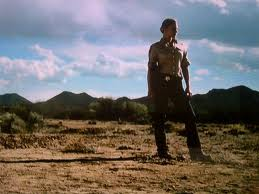
Wyoming is beautiful. It is one of my favorite states. However, if my friends want to see the landscapes of Longmire, then they will need to go to northern New Mexico, the filming location. I thought it looked familiar because I was just there. Anyway, I had to explain that westerns are not always filmed where the story takes place and that it has confused audiences for decades. I wondered how many people will watch the show and think that Wyoming looks like New Mexico.

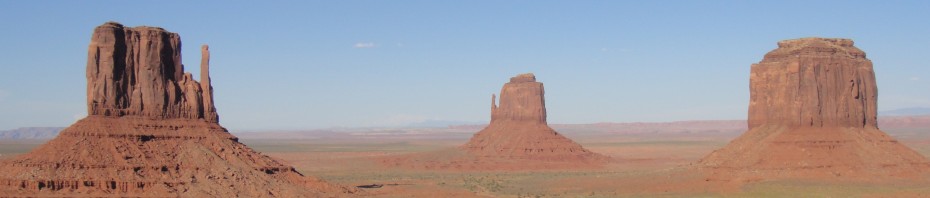
Today, another example of filming that confused the audience popped up on my television. The Searchers, starring John Wayne as Ethan Edwards, is one of my favorite movies. It follows a loner who goes on a decade-long trek to find his niece who was abducted by Comanche. I could write about this movie all night but need to focus on the scenery in which the action takes place. The director, John Ford, used his favorite filming location, Monument Valley, because of its grand vistas. In fact, I used a photograph of Monument Valley for the banner above.

The problem is that the story takes place in Texas while Monument Valley sits in Utah. Through the years, I wonder how many people think Texas, an iconic locale for western stories, looks like that. I can promise that it doesn’t.

People have always imagined the West differently. In the 1800s, misconception was understandable because technology and transportation did not offer easy opportunities to see it. During most of the 1900s, a trip into the West was also difficult for many. However, today, with interstates and internet, there is not excuse for imagining the West incorrectly. I urge everyone, if provided with the opportunity, to travel through it and see for yourselves.

Wyoming does not look like New Mexico, and Texas does not look like Utah. However, each of those places and all of the rest have a beauty all their own. Don’t be fooled by the movies and television because the West is more magnificent than they can show and you can imagine. Plus, it will all be in the right places.

You Gotta Have Faith?

28 May

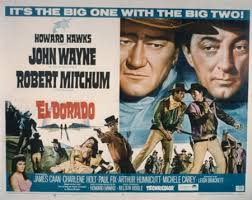
There is an old John Wayne movie called El Dorado that I have seen a million times and contains one of my favorite lines. After telling one of his henchmen to stay out of a fight, Nelse McLeod, the bad guy gunfighter, says, “Faith can move mountains, Milt, but it can’t beat a faster draw.” This line kept running through my mind as I read The Devil in Pew Number Seven by Rebecca Nichols Alonzo.

This book had been in my Kindle for a while as I decided if I wanted to read it or not. Now that I have read it, I am not sure if I’m glad I did or not. I think it is supposed to be a chronicle of faith and how it can get people through any hardship. From my point of view, it provides an example of the tragedies that can happen if someone has too much faith.

In short, the writer is the daughter of a preacher and his devout wife and takes us through her childhood experiences. However, they are not the experiences that one would find idyllic. Her father was the pastor at a church in a small, rural community in North Carolina. Like many similar communities, it was tight-knit and leery of outsiders. Being a dynamic preacher, her father was able to break through this outsider status and become a beloved figure in the area.

At least, he was beloved to most. Apparently, there was a local “boss” who did not appreciate the new preacher and his growing power. As time passed, the “boss” did everything possible to run the preacher and his young family out of town. It began with disturbances during services, such as making loud noises and slamming the doors. Through the years, it escalated from childishness to danger. Hired lackies made threatening phone calls, mailed threatening letters, shot up the house and, eventually set off dynamite near their home and the church. For years, the family lived in terror as the attacks increased in ferocity. Everyone knew who was behind it, but authorities could not prove it.

Over time, the preacher and his wife strained under the stress. The children, the writer and her brother, spent nights not sleeping or having nightmares. It was a disaster as this family faced the wrath of a man bent on destroying them. Neighbors rallied, journalists wrote and politicians spoke, but no one could understand the nightly fear that this family faced. It is a story that makes the reader wonder about the depths to which some will resort to get their way.

However, it made me wonder about something else as well. The writer continuously praises the faith that her parents had in God. They refused to move because God would protect them. They refused to confront the terrorist because God would find His way into the man’s heart. They would not give up the small church because God wanted them there. Family begged them to move, but God didn’t want them to move.

Look, if someone has faith in a higher power, then that is their right. If someone has enough faith to place themselves in harm’s way for that higher power, then that is fine by me. I don’t understand it, but it is their life. However, I have a real problem when someone uses faith as an excuse to keep someone else in danger. This couple forced their children, who had no choice, to live a terrible childhood, because that’s what God wanted. THAT IS RIDICULOUS. I heard somewhere that God helps those who help themselves. Placing innocents in a dangerous situation because of faith is criminal. In my mind, it is just as criminal as the people setting the dynamite.

In the end, God didn’t come to the rescue. As the family harbored an abused wife, her husband walked into their home and shot both parents. The mother was killed almost instantly, and the father survived physically. He did not, however, survive mentally. After spending time in various institutions, he died of a blood clot.

The writer finishes by describing the strength of her faith and how it got her through. Various reviewers write about how this is such a great testament to faith. I say that it is a testament to stubbornness – a testament to putting your children through Hell while telling them that is the way to Heaven.

Charting a Mystery

16 Feb

A month ago I wrote a post about old posts that we have probably forgotten about and how they don’t disappear but hang around in cyberspace until cyberspace collapses on itself. The post about “old posts” was inspired by the second ever post I published on this site – an ode to the peculiarities of gas pumps. It had never gotten any hits, then, all of a sudden, a person took a look at it. Needless to say, I was thrilled that some of the things I had written while wandering in this newfound wilderness of blogging had been read. I went back to look at it again. I wrote a new post about the experience. Then, I went on my merry blogging way.

Then, something strange happened. It got another hit. And another one. And another one. On and on it went for days. Each time I looked at the “Site Stats” another search engine term was popping up.

gas pumps

gasoline pump

pushing credit or debit at a gasoline pump

gasoline pump pictures

pictures of gasoline pumps

In a matter of weeks, a post that laid dormant forever and had been given up as unreadable and forgotten had just gone to the top of the Hit Parade. Once lagging behind at a total of ZERO hits, the sarcastic look at pumping gas reached the top of the charts and passed such favorites as:

Dirty Deeds and Thunder Chief

Guns ‘n Roses in Nashville

John Wayne and Edgar Allan Poe

It seemed that I had a mystery on my hands and needed the help of those meddling kids in the Mystery Machine. Have gas pumps suddenly gained a new popularity? Are people becoming interested in the intricacies of debit and credit card use? Has this become the hip thing to look up among hipsters?

To solve the mystery, I started up the search engine and began looking myself. Starting with the simplest search term, I typed in “gas pumps” and looked around. Page after page, I could not find a reference to the “Surrounded by Imbeciles” world. Then, I shifted to images, and, behold, “Surrounded by Imbeciles” appeared as the first entry on the first line.

Part of the mystery was solved, searchers had come to me through the photo I uploaded to the post. When they hit images, there it appeared. However, a second mystery remains. Why, in the middle of January, did gas pumps become so popular? Even after being forced to watch Murder, She Wrote as a kid, I don’t believe I have the sleuthing talents to figure it out. Perhaps, you readers can help. Or, maybe I should call the In Search Of version of Leonard Nimoy.

King of the Pecos

11 Feb

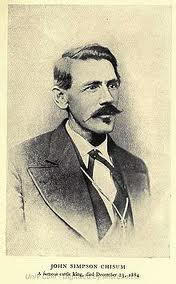
Did you know the King of the Pecos was from Tennessee? Born in Hardeman County in 1824, John Chisum’s family moved to Texas when he was a teenager. As Chisum grew older, he became a leader in the booming cattle industry of the area and provided beef for reservations in New Mexico. As a result, Chisum moved his operation to a 100 mile range on the Pecos River.

With his 60,000 head of cattle, Chisum became known as the King of the Pecos. As his wealth grew, other cattlemen challenged Chisum’s power, and the famous Lincoln County War ensued, an event that made Billy the Kid famous. Chisum died in 1884, but he has been immortalized on film by such stars as James Coburn and John Wayne. While the portrayals have not been accurate, they have made for some entertaining movies and memorable quotes. Consider the following from Wayne’s Chisum.

James Pepper: You know there’s an old saying. There’s no law west of Dodge and no God west of the Pecos. Right, Mr. Chisum?

John Chisum: Wrong, Mr. Pepper. Because no matter where people go, sooner or later there’s the law. And, sooner or later they find God’s already been there.

Your Assignment…Should You Choose to Accept

27 Jan

This semester I have the good fortune of teaching my favorite class, a history of the American West. This is my major area of study, and I get a kick out of talking about all of the things I have researched and written about. However, it needs to be fun for the students as well. I believe that many historians do a wonderful job of making an interesting topic as boring as possible, and I attempt the opposite. History is fun for me, and I want the students to have the same experience.

Several years ago, I developed something that the students call the “Movie Assignment”. They watch a movie based within the time period we are discussing and compare it to actual events. The scenery and action of the films provide them with a visual clue of what may have been like, and the story often gives them an idea of life itself. Obviously, not all movies are appropriate for this type of activity. Pearl Harbor may have been the dumbest plot ever written. Therefore, World War II class did not get the option to watch it. They got movies with deeper meanings and more of a foundation in reality.

In the American West, students have the pleasure of watching films from my favorite genre. Except, there is a different aspect to the assignment. Western settings have long been used to offer more contemporary lessons. Think of it as the Mt. Olympus of the United States. It is the place with myths are made, and flawed heroes face decisions with no correct answers. To get the students on the right path, I recently assigned each of them a movie to watch. We haven’t discussed what they should look for because I want them to watch the movies for enjoyment first. This post lists the movies and why I chose them. If you get the chance to watch them, then perhaps these are things you can look for.

1. Rango– I know, it’s a cartoon. However, it pays homage to westerns throughout the decades. Watching closely, you can pick up small details that bring to mind the great western movies and western actors. Besides, how can a movie be bad when “The Man With No Name” shows up as the Spirit of the West. I only that the original “Man With No Name” could have been used to voice the character.

2. The Man Who Shot Liberty Valance – “This is the West, sir. When legend becomes fact, print the legend.” One of the great lines in western history and an statement that describes how difficult it is for historians to dig through the legend to get to the fact. This film is filled with symbolism, as each character represents an aspect of the “taming of the frontier” experience.

3. Fort Apache – The second John Ford/John Wayne movie on the list (TMWSLV was the first), this is one of the first movies to show Native Americans in a positive light. It takes real battles of the Indian Wars and combines them into a fictional one. In the process, it shows the misguided policies of the United States toward native peoples. This could be relavent for a lot of times in history – Indian Wars, Vietnam War, Gulf War.

4. The Searchers – The third John Ford/ John Wayne installment (I promise that they don’t make up the entire list) is an epic about a man searching for his niece, who was kidnapped by Indians. It shows his maniacal racism toward these people and how it increases throughout the film. Most of the underlying currents were missed by the audiences of the time, but they come to light as the years pass.

5. The Magnificent Seven – A remake of the Japanese film, The Seven Samurai, this movie was had a compliation cast of stars in an action packed adventure. However, many don’t realize that the original Japanese film was a western placed in a different time and place. So, a western copied a foreign film that copied a western storyline. This shows that the themes of the western genre are actually universal.

6. Dances With Wolves – The Kevin Costner movie won the Academy Award for Best Picture. did you know it’s more popular “remake” lost the same award? Avatar has made more money than any movie in history, but it should be renamed to Dances With Aliens. It’s the same storyline. Watch them back to back and see what I mean. This shows that the western never disappeared. It simply got better graphics and tuend into Sci-Fi. For example, Gene Roddenberry was a writer for Wagon Train when he pitched Star Trek as “Wagon Train to the stars”. And , can’t you picture the black-hatted darth vader as a cattle baron building his empire on the backs of settlers (before the later movies became some convuluted political statement)? Also, when Luke returns to find his uncle’s homestead burning, it reflects Ethan Edwards returning to find his brother’s homestead burning in The Searchers.

7. Pat Garrett and Billy the Kid – Sam Peckipah uses this movie to depict his idea of the destruction of the American west. Look at all of the western character actors that are killed or shown in stages of degeneration. Peckinpah’s version of western history is inaccurate, but his portrayal of the disappearing frontier is poignant. Plus, Slim Pickens dies with Bob Dylan singing “Knockin’ on Heaven’s Door”. The best dying scene ever.

8. The Outlaw Josey Wales – There should be a law that says everyone has to watch this movie once a year. Josey sees his life ripped apart by the ravages of war. In response, he becomes a gunfighter to reap revenge on those who killed his family. Along the way, he picks up a surrogate family of people who have seen their lives destroyed by violence and hardship. It turns out that the “loner” isn’t alone after all. Filmed in the mid-1970s, the Civil War and its aftermath can easily be seen as the Vietnam War.

9. Bury My Heart at Wounded Knee – An attempt to depict the plight of Native Americans as they saw their lifestyle and land taken away. It is a noble attempt. Unfortunately, there are a lot of inaccuracies. The Native American story needs to be told and can be told in an accurate and informative way. This movie, in an attempt to tell the other side of the story, goes to far the other direction. As in all conflicts and clashes of cultures, there are good and bad people on both sides. Portraying that inaccurately takes the meaning away from all of them. On top of that, the portrayal of the Battle of Little Big Horn is shameful.

10. High Noon – This movie is not exciting at all. And, I cringed each time I see the sheriff ask for help. However, there is a reason he does. This movie places real life events in another setting as the sheriff represents those victimized by the House on Un-American Activities Committee that was led by Joseph McCarthy. Audiences of the time would never watcha movie about a supposed communist, but they would watch a movie about a sheriff in trouble.

11. Jeremiah Johnson – Based on an actual mountain man, Robert Redford shows the harshness of life as a Rocky Mountains trapper. There are accuracies and inaccuracies, but the overall story is true to the experience. The scenery is fantastic and the dialogue is witty and appropriate. Under the current, you find the story of a man who tries to run away from civilization only to find that it is never far away.

12. The Good, the Bad and the Ugly – A western about the Civil War in New Mexico that was filmed in Europe. What else can I say? When it came out, many movie critics panned it because everyone knows that the Civil War took place in the east. Wrong. It is based on a reall mission to capture what is now New Mexico. This movie shows how westerns influenced film makers in other countries and how they, in turn, influenced the genre and the view on the region’s history. Also, the musical score is the best of any western ever. And, an American didn’t compose it. Weird for those people who believe the west is all about independence and the American ideal. It wasn’t about that at all.

So, there is the list for my students. Can you think of any other movies I should have used instead? Do you think my students will stumble upon this in their research. If they ever get away from Wikipedia that is.

John Wayne and Edgar Allan Poe

16 Nov

A lot of blog subjects passed through my mind today. I contemplated sharing my classroom experiences and even the lunch I had with my friend Dave. However, I am not in the right frame of mind to write about Latin America, World War II or the experience of eating at the Colonel’s Buffet.

I have been thinking quite a bit about the Natalie Merchant concert. I attend many concerts, but it is the rare occasion when I continue to think about them a few days later. However, this one reached me to the core. I found her poetry songs interesting and have perused iTunes (there goes my iAddiction again) while contemplating purchasing a few. While listening, I began to think about my favorite poems. I am not a big poetry fan, but, as with everyone, some catch my fancy.

“Eldorado”, by Edgar Allan Poe, is my all-time favorite. The weird part is that I didn’t learn it from an English class or from discussing poetry in a coffeehouse. I learned it by watching a John Wayne movie.El Dorado

While I was growing up, my dad and older brother watched John Wayne movies all of the time. Wanting to be involved, I watched them too and began to memorize some of them. I especially latched on to “El Dorado”, which starred Wayne, Robert Mitchum and James Caan. Wayne played Cole Thornton, a gunfighter who owed a local ranching family for a tragic accident. Mitchum was J.P. Harrah, friend of Thornton who became a drunken sheriff. Caan played Mississippi, a young gambler that Thornton befriends. As the movie unfolds, the three of them, along with the comedic sidekick, fight against and defeat the rich, bad guy rancher.

Throughout the film, Mississippi recited lines from a poem about a gallant knight that I thought the writers of the movie came up with. As I researched the movie, I learned that it was the poem by Poe. Goes to show you that anything can be learned from any source. John Wayne taught me poetry and led me to become a historian who researches the history of the American West.

So, today’s mindset led me to poetry, and, for those who have never read it, here is “Eldorado”.

Gaily bedight,

A gallant knight,

In sunshine and in shadow,

Had journeyed long,

Singing a song,

In search of Eldorado.

But he grew old-

This knight so bold-

And o’er his heart a shadow

Fell as he found

No spot of ground

That looked like Eldorado.

And, as his strength

Failed him at length,

He met a pilgrim shadow-

“Shadow,” said he,

“Where can it be-

This land of Eldorado?”

“Over the Mountains

Of the Moon,

Down the Valley of the Shadow,

Ride, boldly ride,”

The shade replied-

“If you seek for Eldorado!”